
Certification marks on pro convection ovens generally fall into three categories: mandatory legal requirements, voluntary safety and performance standards, and decorative marketing labels. In the United States and many other regions, certain electrical and safety certifications are legally required for the sale of commercial appliances. Voluntary marks, such as those from third-party safety organizations, provide additional assurance regarding construction quality and operational safety. Decorative labels, which may include manufacturer-specific “pro-grade” badges or non-standard icons, offer no verifiable protection or performance guarantees and should be ignored during the evaluation process.
What does NSF certification mean for a convection oven?
NSF certification is issued by the NSF International organization to verify that a piece of equipment meets specific public health and food safety requirements. For a pro convection oven, this means the unit is designed with materials and construction methods that prevent food contamination and are easy to sanitize. The mark guarantees that the stainless steel surfaces, internal components, and drainage points meet hygiene standards for commercial food preparation.
NSF certification does not guarantee the oven’s cooking performance, such as its heat distribution, temperature accuracy, or the speed of its convection fans. It is a sanitary standard, not a culinary one. A unit can be NSF certified while still producing uneven heat or failing to reach the required internal temperatures for specific high-volume tasks.
Where these choices show up in our reviews
From $339.86 to $2080: the 3 in this category we have reviewed in full.
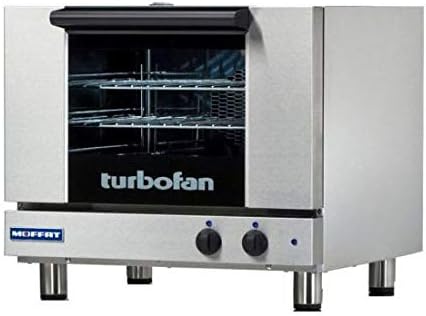
Moffat E22M3 24″ Countertop Convection Oven
$2080 price checked August 2026
Read our full Moffat E22M3 Oven review
If you need a compact unit for a small kitchen, see our guide to the best countertop convection oven with digital controls.


Winco ECO-250 Quarter-Size Countertop Convection Oven
$339.86 price checked August 2026
Read our full Winco ECO-250 review
You might also consider exploring different convection oven alternatives if a standard unit doesn’t fit your workflow.
What do UL and ETL listings guarantee?
UL (Underwriters Laboratories) and ETL (Intertek) are recognized safety marks that indicate the appliance has undergone rigorous testing for electrical safety and fire hazards. These marks ensure that the wiring, heating elements, and insulation of the convection oven meet national safety codes to prevent electrical shocks or fires during operation. These are the primary safety marks you should look for on any commercial kitchen appliance.
These listings do not guarantee the longevity of the heating elements or the efficiency of the convection system. They certify that the oven is safe to plug in and operate under normal conditions, but they do not certify that the oven will maintain a specific temperature or that the fan motor will remain functional for a specific number of hours. They are safety benchmarks, not performance benchmarks.
Which safety standards address convection oven failure modes?
The primary safety failure modes for pro convection ovens include electrical short-circuiting, overheating of the outer chassis, and thermal runaway of the heating elements. UL and ETL listings specifically address these risks by testing the unit’s ability to automatically shut off or vent heat if internal temperatures exceed safe thresholds.
Another critical failure mode is uneven heat distribution, which can lead to scorched edges or raw centers in large-batch baking. While no standard “certifies” a perfect bake, high-quality convection ovens often utilize heavy-duty fan motors and specialized air-flow baffles. You should look for specifications regarding the fan’s CFM (cubic feet per minute) or the number of fan speeds, as these technical values provide more evidence of performance than a general safety mark.
How can you verify a safety mark is real?
Manufacturers may print logos on the exterior of a convection oven that are not backed by actual testing. To verify that a certification is legitimate, perform the following checks:
- Locate the physical certification plate, which is usually a metal tag riveted to the frame or the back of the unit, rather than just a sticker on the door.
- Verify the specific certification number on the plate against the manufacturer’s official documentation or the certifying body’s public database.
- Check that the mark includes the specific testing body’s name (e.g., “UL Listed” rather than just a generic “U” logo).
- Confirm that the certification covers the specific voltage requirement of your facility, such as 240V, as a 120V certification may not apply to a high-wattage commercial unit.
Which marks are non-negotiable for a pro convection oven?
For a professional kitchen environment, UL or ETL listing is a non-negotiable requirement for safety and insurance compliance. Without these recognized marks, a convection oven may not meet the fire safety codes required for commercial operation, and its use could void your facility’s insurance coverage. These are the baseline requirements for any commercial kitchen equipment.
NSF certification is a high-priority mark but may be weighed against your specific workflow requirements. While it ensures the unit is sanitary, some specialized ovens may lack it if they are used for non-food applications. For standard bakery or restaurant use, however, an NSF mark is a significant indicator of a well-engineered commercial product. You should prioritize these two marks over any manufacturer-specific “professional” labels, which provide no verifiable data regarding the safety or durability of the oven.
More Pro Convection Oven explainers and comparisons
- Countertop Convection Ovens for Large Sheet Pans Compared
- Choosing the Best Countertop Convection Oven with Digital Controls
- The Pro Convection Ovens That Work Best for Baking
- Commercial Countertop Convection Ovens for Pizza Baking Compared
- Choosing the Best Half Size Countertop Convection Oven
- The Quarter Size Countertop Convection Ovens That Work Best for Small Spaces