
Bowl Count refers to the number of distinct basins integrated into a fireclay farmhouse kitchen sink. The number of bowls you choose depends on your specific kitchen workflow, the volume of cookware you typically prepare, and the physical footprint of your cabinetry.
Which Bowl Count is right for my kitchen?
| If this is you | The Bowl Count that suits you | Why |
|---|---|---|
| You primarily cook for one or two people and prefer a minimalist, uncluttered countertop. | 1 | A single large basin provides maximum workspace for large items like roasting pans without dividing the area. |
| You frequently prepare large family meals and need to soak heavy pots while rinsing vegetables simultaneously. | 2 | Two basins allow for a “wet” and “dry” zone, preventing dirty items from coming into contact with fresh produce. |
| You host large gatherings and require a high-volume area for rapid cleanup of multiple dishes. | 2 | A double bowl configuration speeds up the clearing process by allowing two people to work in the sink at once. |
| You have a very large kitchen island and want to create a dedicated prep and cleaning station. | 2 | Separating tasks into two distinct basins prevents water from splashing across the entire sink surface during heavy use. |
Where these choices show up in our reviews
From $189 to $459: the 3 in this category we have reviewed in full.

DeerValley Double Bowl White 33 inch Farmhouse Sink
$326.76 price checked August 2026
Read our full DeerValley Double Bowl Sink review
If you need more prep space, compare the best fireclay farmhouse sink for double bowl options.
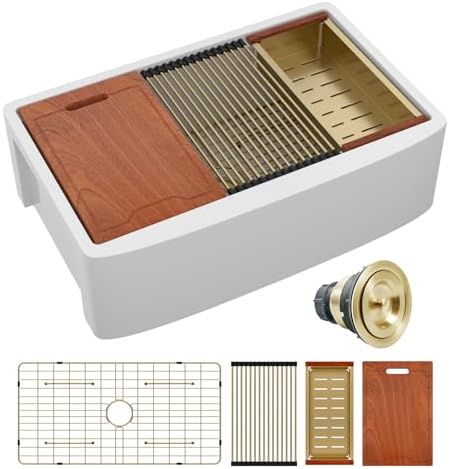

24 Inch White Fireclay Farmhouse Sink
For those on a strict budget, find the best fireclay farmhouse sink for small kitchens under $250.
$189 price checked August 2026
How do I establish my required Bowl Count before ordering?
To establish your required Bowl Count, you must first audit your most frequently used cookware and your available countertop space.
Audit your most used cookware
Identify the largest items you cook with regularly, such as stockpots, roasting pans, or oversized baking sheets. If your most common large items require a wide, unobstructed area to sit flat, a 1-bowl count provides the most usable surface area. If you find yourself constantly moving items out of the way to wash something else, a 2-bowl count provides the necessary separation.
Proper sizing is vital, so learn how to choose the right width for your layout.
Verify your cabinetry footprint
Measure the width of the cabinet base where the fireclay farmhouse kitchen sink will sit. A 2-bowl count often requires a wider cabinet to accommodate the internal plumbing and the physical width of the two basins. Ensure your cabinetry can support the total width of the sink’s exterior dimensions, as fireclay material is heavy and requires a stable, correctly sized base.
Where to find the Bowl Count in specifications
The Bowl Count is typically listed in the “Configuration” or “Basin Type” section of the manufacturer’s technical specifications. It will be explicitly stated as either “Single Bowl” or “Double Bowl” (or “2-Bowl”). Always verify the internal dimensions of each bowl, as the total width of the sink can vary even if the Bowl Count is the same.
What happens if I choose the wrong Bowl Count?
Choosing a Bowl Count that does not align with your habits leads to specific functional failures during daily kitchen use.
The risks of a single bowl for high-volume tasks
If you require a 2-bowl setup but choose a 1-bowl count, you will experience a bottleneck during cleanup. You may find yourself forced to wash items in stages, as there is no secondary basin to hold soapy water or to hold items waiting to be dried. This can lead to a cluttered sink where dirty and clean items mix because there is no physical partition.
The risks of a double bowl for large cookware
If you choose a 2-bowl count but primarily cook with very large, wide roasting pans, the individual basins may be too narrow. A 2-bowl configuration splits the total sink width into two smaller sections; if these sections are narrower than your largest pan, the pan will not sit flat. This forces you to wash the item in a single bowl, potentially leaving one side of the sink unused and creating an awkward workflow.
To ensure your pots fit comfortably, view our guide on choosing the correct depth.
What should I do if I am between a 1-bowl and 2-bowl count?
If you are undecided between a 1-bowl and 2-bowl count, determine your decision based on your “primary” kitchen activity.
Prioritize preparation versus cleanup
If your primary goal is food preparation, a 1-bowl count is often the better choice because it offers a larger, contiguous basin for washing oversized items. If your primary goal is efficient cleanup and organization, a 2-bowl count provides the necessary separation to keep different tasks from interfering with one another.
The final measurement check
Before finalizing your choice, confirm the internal width of the individual basins. If you choose a 2-bowl count, ensure the width of a single basin is at least 2 inches wider than your largest standard pot. If it is not, you may find the 2-bowl configuration impractical for your specific needs, and you should reconsider a 1-bowl count that offers a wider total span.
Because fireclay is a heavy, permanent material, it is important to confirm all dimensions with a qualified installer before purchase. Ensure the chosen Bowl Count aligns with your plumbing layout and that the installer can verify the structural support required for the specific sink weight and size.
The rest of our Fireclay Sink guides
- Which Fireclay Farmhouse Sink Is Best for Deep Cleaning?
- Best Fireclay Farmhouse Sinks Under $500
- The Fireclay Farmhouse Kitchen Sinks That Work Best for Large Families
- Which White Fireclay Apron Front Sink Is Best?
- Best Fireclay Farmhouse Sinks for Small Kitchens Under $250
- Double Bowl Fireclay Farmhouse Sinks Compared