
When shopping for a fireclay farmhouse kitchen sink, most marketing copy focuses on aesthetic “warmth” or “hand-crafted” appeal. While these are subjective preferences, the load-bearing terms are those that dictate the sink’s physical durability and its ability to fit into your cabinetry. You should prioritize specifications regarding fireclay density, wall thickness, and depth over stylistic descriptors. A sink that looks correct but lacks the correct thickness will sag or crack under the weight of water, rendering the aesthetic value moot. Focus on the technical measurements of the apron front and the interior dimensions to ensure the unit functions as a heavy-duty workstation.
Fireclay Material and Durability Standards
- Fireclay – A dense, ceramic-like material made from fired clay that provides a non-porous surface and high heat resistance. High-density fireclay is the standard for preventing thermal shock cracking.
- Thermal Shock Resistance – The ability of the sink to withstand rapid temperature changes, such as moving from boiling water to cold water. Higher resistance is better for preventing fractures in the sink body.
- Surface Porosity – The measure of how much liquid the glaze can absorb into the clay body. A lower porosity rating is better, as it prevents permanent staining and bacterial growth.
- Wall Thickness – The measurement of the clay’s thickness across the sink’s span. Thicker walls are better for preventing structural sag when the sink is full of heavy cookware.
- High-Density Clay – A specific manufacturing standard where the clay is compressed more tightly before firing. This is the benchmark for durability in high-performance farmhouse sinks.
- Glaze Finish – The protective outer coating applied to the fireclay. A high-quality glaze is essential for maintaining the sink’s color and resisting scratches from metal utensils.
Where these choices show up in our reviews
These 3 have their own full review on this site, and run from $200.02 to $990.

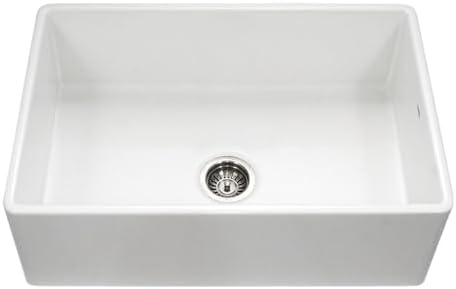
Houzer PTG-4300 WH Platus 33 Inch Farmhouse Sink
$248.39 price checked August 2026
If you are new to this style, learn the basics of farmhouse sinks to understand their unique construction and functional benefits.

Physical Dimensions of Farmhouse Sinks
- Apron Front – The vertical portion of the sink that sits forward from the cabinetry. The width of this front determines the visual “farmhouse” style and the available workspace.
- Internal Depth – The measurement from the bottom of the basin to the top of the rim. A 10-inch depth is the standard for heavy-duty kitchen use, while deeper basins allow for larger pots.
- Internal Width – The usable horizontal space inside the sink basin. A wider basin allows for more efficient multi-tasking and easier cleaning of large items.
- Outer Dimensions – The total footprint of the sink, including the apron. You must confirm these measurements against your cabinet opening before ordering to ensure the sink fits.
- Rim Thickness – The width of the top edge of the sink. A thicker rim provides a more substantial feel and more surface area for mounting hardware.
- Weight Capacity – The amount of weight the sink structure can support when filled with water. Higher weight capacities are necessary for large, deep farmhouse models to prevent bowing.
Installation and Compatibility Terms
- Drop-In Mount – A mounting style where the sink sits on top of the counter and is secured with clips. This is the standard for most farmhouse sink installations.
- Undermounting – A method where the sink is attached to the underside of the countertop. This is less common for apron-front sinks but may be used for standard farmhouse styles.
- Front-Mount – A synonym for apron-front where the sink is installed so the front face is visible. This is the primary style for the farmhouse aesthetic.
- Overflow Hole – A small opening in the basin that prevents water from spilling over the edges if the faucet is left running. A standard overflow is necessary for most residential plumbing.
- Drain Configuration – The placement of the drain, which can be center, left, or right. The position should be chosen based on your specific workflow and plumbing layout.
- Material Compatibility – The list of substances the sink can safely contact. Fireclay is generally compatible with most household chemicals, but you should confirm the specific glaze’s resistance to acidic foods.
Commonly Confused Sink Terms
Buyers often confuse the physical dimensions of the sink with the requirements of the cabinetry. It is important to distinguish between the “Outer Dimensions” and the “Cabinet Opening” size.
- Apron Front vs. Drop-In – An apron front is a specific type of drop-in sink where the front face is exposed. All apron-front sinks are drop-ins, but not all drop-in sinks are apron-fronts.
- Fireclay vs. Ceramic – While similar, “fireclay” refers to a specific high-density clay fired at higher temperatures than standard “ceramic.” Fireclay is the preferred material for farmhouse sinks due to its superior durability.
- Interior Depth vs. Exterior Height – Interior depth is the space available for washing, while exterior height includes the thickness of the rim and the apron. You must measure your clearance based on the exterior height.
- Porosity vs. Texture – Porosity refers to how much liquid the material absorbs (a technical durability factor), while texture refers to how the surface feels (a tactile preference). You want low porosity regardless of the texture.
Browse our other Fireclay Sink pages
- The Fireclay Farmhouse Kitchen Sinks That Work Best for Large Families
- Which White Fireclay Apron Front Sink Is Best?
- Best Fireclay Farmhouse Sinks for Small Kitchens Under $250
- Double Bowl Fireclay Farmhouse Sinks Compared
- Choosing the Best Fireclay Farmhouse Sink for Heavy Duty Use
- The Fireclay Farmhouse Sinks That Work Best for Modern Farmhouse Style