
Most home cooks need kitchen cutlery with a steel hardness between 56 HRC and 60 HRC. This range balances the ability to maintain a sharp edge with the durability required for daily food preparation.
Recommended Steel Hardness by Use Case
| Use Case | Recommended Steel Hardness | Why this number |
|---|---|---|
| General Food Prep | 56–58 HRC | Provides sufficient edge retention for vegetables and proteins while remaining resilient against minor impacts. |
| Heavy Duty Butchery | 54–57 HRC | Lower hardness prevents the blade from chipping or rolling when encountering bone, cartilage, or heavy pressure. |
| Precision Slicing | 58–60 HRC | Higher hardness allows for a thinner, more acute edge that stays sharp longer during delicate tasks like fish or herbs. |
| High-Volume Commercial | 56–59 HRC | Balances the need for frequent sharpening with the necessity of a blade that survives heavy, repetitive cycles. |
Kitchen Cutlery covered by our own reviews
These 3 have their own full review on this site, and run from $119.99 to $169.99.
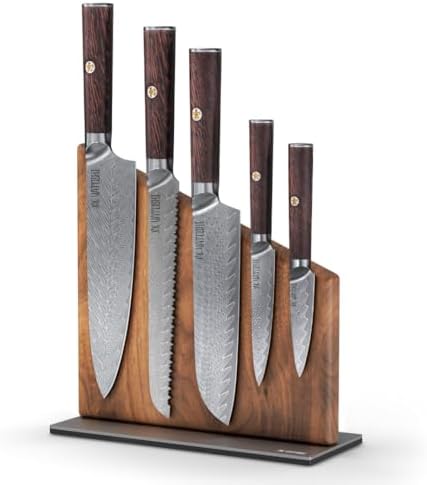
Yatoshi Knives Magnetic Kitchen Knife Block Set
$119.99 price checked August 2026
Read our full Yatoshi Magnetic Knife Set review
If you are starting your collection, explore the best entry-level japanese kitchen knife set options for high-quality craftsmanship on a budget.
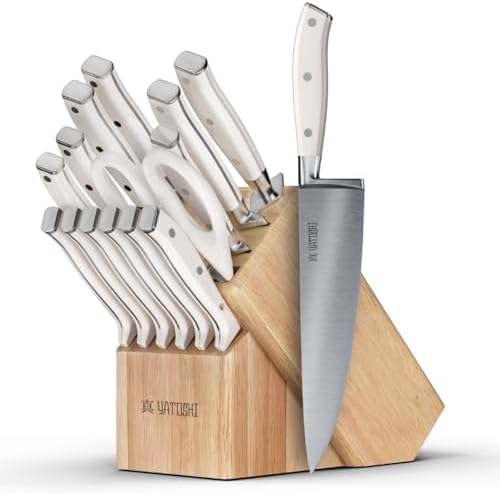

SHAN ZU K133 Japanese Super Steel Knife Set
$169.99 price checked August 2026
For those prioritizing versatility, find the best kitchen knife set for home cooks based on our detailed performance analysis.
Risks of Under-Provisioning or Over-Buying Hardness
Under-provisioning occurs when you select steel with a hardness rating below 54 HRC. At these lower levels, the steel is relatively soft, meaning the edge will dull quickly during routine tasks like slicing a tomato or dicing an onion.
The Problem with Low Hardness
Soft steel lacks the structural integrity to hold a microscopic “bite” on the surface of the metal. You will find yourself needing to sharpen the blade more frequently, which can lead to a rounded edge that slides off the food rather than cutting through it. While these blades are very easy to sharpen, the time spent maintaining them often outweighs the benefit of the softer material.
Over-buying hardness involves selecting steel that exceeds 62 HRC for standard kitchen use. While high hardness sounds like a benefit, it introduces a significant risk of micro-chipping and brittleness.
The Risk of Brittle Steel
Steel that is too hard behaves more like glass than metal. If the blade meets a hard surface, such as a large bone or a ceramic plate, the edge can chip or crack rather than bending slightly. This makes the tool less versatile because you must be extremely cautious about what the blade touches. Furthermore, extremely hard steel is notoriously difficult to sharpen at home, often requiring specialized equipment and professional-grade techniques to restore the edge.
Before making a purchase, review kitchen cutlery warranties to check before buying to ensure your investment is protected.
The Mistake of Prioritizing Hardness Over Edge Geometry
The mistake most buyers make with steel hardness is assuming a higher HRC number automatically results in a “sharper” knife. Hardness is a measure of how well the steel holds its shape; it is not a measurement of the actual sharpness of the blade’s edge.
Why Geometry Matters More
You should optimize for the bevel angle and the grind of the blade instead of just the HRC number. A knife with 60 HRC hardness and a thick, dull bevel will perform worse than a 56 HRC knife with a precision-honed, acute edge. The geometry determines how much material is removed from the blade to create the cutting surface. If the geometry is too thick, the knife will feel like it is “crushing” the food; if it is too thin, the blade may fail under pressure regardless of its hardness.
How Steel Hardness Interacts with Other Deciding Specs
Steel hardness interacts with the metallurgy of the blade, specifically the balance between carbon content and chromium levels. A high HRC figure is often wasted if the blade’s composition does not support the necessary corrosion resistance for a kitchen environment.
The Corrosion Trade-off
High-carbon steels can reach very high hardness levels, but they are prone to oxidation and staining. If you choose a very hard, high-carbon blade, you must commit to rigorous maintenance, including immediate drying and oiling. For many home users, a slightly lower hardness in a stainless steel alloy is more practical because it offers a balance of edge retention and ease of cleaning.
The Physical Construction Limit
Hardness is also limited by the construction of the blade, such as whether it is a full tang or a partial tang design. A high-hardness blade in a poorly constructed handle assembly can lead to handle detachment or structural failure under lateral pressure. The steel must be supported by a robust geometry that distributes the force of the cut across the entire body of the knife, rather than concentrating the stress on a single point of the hardened edge.
More Kitchen Cutlery explainers and comparisons
- Choosing the Best Disposable Cutlery Set for Parties
- Best Damascus Kitchen Knife Sets for Home Cooking
- Japanese Kitchen Knife Sets for Precise Food Prep Compared
- Choosing the Best Kitchen Knife Set with Block for Home Cooking
- The Chef Knife Sets That Work Best for Home Cooks
- Which Steak Knife Set Is Best for Home Dining?