
Most gas metal arc welding tasks require a wire feed speed between 150 and 400 IPM depending on the wire diameter and material thickness. You should select a machine capable of reaching these speeds to ensure consistent weld penetration and bead shape.
Recommended Wire Feed Speeds by Use Case
| Use Case | Recommended Wire Feed Speed | Why this number |
|---|---|---|
| Thin Sheet Metal (0.030″ – 0.063″) | 100 – 200 IPM | Lower speeds prevent burn-through on thin gauges. |
| General Fabrication (1/8″ – 3/16″) | 200 – 350 IPM | Provides the balance of heat and deposition for standard steel. |
| Heavy Plate (1/4″ and thicker) | 350 – 500+ IPM | Higher speeds allow for the high deposition rates needed for thick material. |
| Flux Core Welding (FCAW) | 250 – 450 IPM | Flux core typically uses larger wire diameters requiring higher speeds. |
| High-Production Welding | 400+ IPM | Maximizes output for thick sections and heavy industrial applications. |
Products in this category with a full review here
These 3 have their own full review on this site, and run from $104.99 to $359.99.

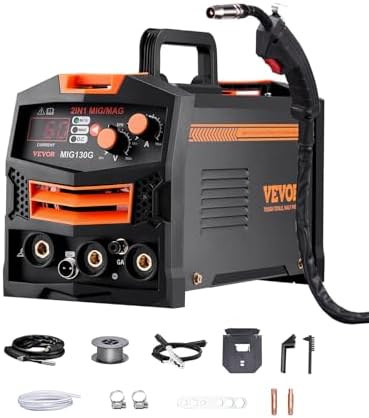
VEVOR 130A Synergic MIG Welder
$104.99 price checked August 2026
Read our full VEVOR 130A MIG review
If you are just starting out, you should compare the best 110V MIG welder for beginners to find a manageable entry point.

What Happens if You Under-provision or Over-buy Wire Feed Speed?
Under-provisioning occurs when your gas metal arc welder cannot reach the IPM required for the wire diameter you are using. If the wire feed speed is too low for the thickness of the metal, the welder will struggle to deposit enough material to create a proper bead. This often results in “cold” welds where the metal does not fuse deeply, leading to structural weakness or a weld that simply peels away from the base material.
Risks of Low Wire Feed Speed
When the wire feed speed is insufficient, the welder may experience frequent “bird nesting” where the wire bunches up at the drive rolls because it cannot move into the weld pool fast enough. You might also notice the weld bead looks pinched or narrow, as the arc is trying to melt more metal than the wire is providing. This creates a lack of fusion that is difficult to repair without grinding the area back to base metal.
The Cost of Over-buying Wire Feed Speed
Over-buying wire feed speed refers to purchasing a high-output industrial machine when your projects only require low-speed, thin-gauge welding. A machine capable of 500+ IPM typically requires much higher input power and larger internal components. These high-capacity machines often have a larger physical footprint and a higher price point that you do not need if you are only welding automotive panels or thin brackets.
Versatility is key for many hobbyists, so view our top 3-in-1 MIG welder for flux core and stick to see multi-process options.
Furthermore, machines designed for extremely high wire feed speeds may have a smaller range of precision at the lower end of the spectrum. If you only need to weld thin materials, a machine built for heavy-duty production might lack the fine-tuned control required to maintain a steady arc at very low IPM, potentially leading to erratic results on delicate work.
The Mistake Most Buyers Make with Wire Feed Speed
The most common mistake is assuming that a higher wire feed speed automatically results in a “stronger” or “better” weld. Wire feed speed is not a measure of weld strength; it is a measure of how fast the machine can put metal into the joint. Strength is determined by penetration, heat input, and proper amperage settings.
Prioritizing Amperage over IPM
You should optimize for the amperage and voltage requirements of your material first. Wire feed speed is a dependent variable; it must be adjusted to match the wire diameter and the desired deposition rate. If you choose a machine based solely on a high IPM rating without checking if the machine can provide the necessary amperage for your specific material thickness, the machine will be ineffective for your primary tasks.
For example, if you are welding 1/4-inch plate, you need a certain amount of heat (amperage). If the machine can reach a high wire feed speed but lacks the power to provide the necessary amperage to melt that thick plate, the wire will simply lay on top of the surface without penetrating. Always match the machine’s power output to your material thickness first, then ensure the wire feed speed can accommodate the wire size you intend to use.
How Wire Feed Speed Interacts with Other Deciding Specs
Wire feed speed is intrinsically linked to the power source and the wire diameter of the gas metal arc welder. A high wire feed speed is wasted if the power source cannot provide enough amperage to melt the wire at that speed. This is why the relationship between the motor’s capacity and the wire feed system is critical.
Power Source and Duty Cycle Limits
The power source determines the maximum heat available. If you are using a high-speed wire feed on a low-power inverter, the machine may hit its thermal limit quickly. This leads to a duty cycle failure where the machine shuts down to cool itself. You must ensure the power source is rated for the amount of heat your specific project requires, as the wire feed speed is only one part of the equation.
Wire Diameter and Feed Mechanics
Wire diameter is the primary physical limit on wire feed speed. Thicker wire has more surface area and requires more force to push through the liner and through the weld pool. A machine with a high IPM rating is only useful if the drive rolls and liner system are designed to handle the physical resistance of the thick wire required for heavy fabrication. If the drive system is too weak, it will slip or jam regardless of the theoretical IPM rating of the electronics.
Voltage and Feed Speed Balance
Voltage and wire feed speed must be balanced to maintain the “arc gap.” If you increase the wire feed speed without a corresponding increase in voltage, the arc may become unstable or “wander.” If you increase voltage without enough wire feed speed, the arc may become too long and unstable. The ideal setup is a machine that allows you to move in small, precise increments of both values to find the “sweet spot” for your specific material and wire combination.
More Gas Metal Arc Welder explainers and comparisons
- Best 3-in-1 MIG Welders for Flux Core and Stick
- Portable MIG Welders for Small Spaces Compared
- Choosing the Best Dual Voltage MIG Welder for 110V and 220V
- The Gas Metal Arc Welders That Work Best for Gasless Flux Core Welding
- Which Entry-Level Professional MIG Welder Is Best?
- Choosing the Best MIG Welder for Home DIY Projects