
There are three primary types of rebar benders defined by their power source and mechanical movement: manual, hydraulic, and automated systems. The decision between these types depends on the diameter of the bar, the volume of production, and the available power infrastructure at the job site. A manual tool offers portability for small tasks, while hydraulic and automated systems provide the force necessary for large-diameter bars and high-volume output.
What is a Manual Rebar Bender?
A manual rebar bender relies on human physical effort and mechanical leverage to deform steel. These tools typically utilize a heavy-duty lever arm or a “bending brake” design where the user pulls a handle to rotate the bar around a fixed point. Because they do not require electricity or a pump, they are the most portable options available.
Who is a manual rebar bender for?
Manual rebar benders suit small-scale residential projects, hobbyist construction, or repair work where only a few bends are required. If you need to bend small-diameter bars, such as #3 or #4 rebar, a manual tool provides a simple solution that requires no setup. However, manual benders are limited by the physical strength of the operator; they are impractical for heavy-duty reinforcement or high-frequency use.
What are the limits of manual bending?
Manual benders are restricted by the material‘s yield strength and the operator’s capacity. Attempting to bend large-diameter bars with a manual tool can lead to material work hardening, where the steel becomes brittle and prone to snapping rather than bending. These tools generally sit at the lowest price point of the three categories because they lack complex mechanical components.
Where these choices show up in our reviews
Prices across these 3 run from $219.99 to $569.90; each one has a full review here.

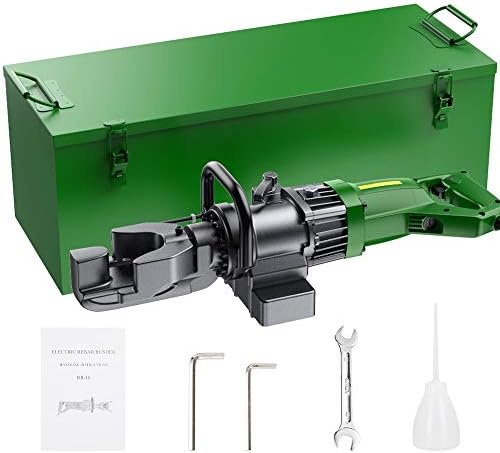

1100 W Hydraulic Rebar Bending Machine
Before purchasing, it is essential to verify rebar bender safety certifications to ensure your equipment meets industrial regulations.
$219.99 price checked August 2026
What is a Hydraulic Rebar Bender?
A hydraulic rebar bender uses pressurized fluid to generate the force required to bend steel. These systems operate on a piston principle, where a pump (either manual or powered) pushes a hydraulic cylinder to move the bending head. This allows for much greater force than a human can generate with a simple lever.
What can a hydraulic bender do?
Hydraulic benders are the standard for medium-to-heavy construction projects. They can handle larger diameters, such as #5 through #8 rebar, with significantly less physical effort than a manual tool. Because they provide consistent pressure, they help ensure a uniform bend radius, which is critical for structural integrity. These systems sit in the middle price tier, offering a balance between portability and power.
Is a hydraulic bender portable?
Hydraulic benders come in two main configurations: portable and stationary. A portable hydraulic unit can be moved around a job site, but it still requires a pump and a hose setup. If you need to bend large bars but lack a permanent power source, a portable hydraulic unit provides the necessary force without the need for a full CNC line.
What is an Automated Rebar Bender?
An automated rebar bender is a stationary machine, often a CNC-controlled system, that uses electric motors and sophisticated programming to shape steel. These machines are designed for high-volume production environments, such as pre-cast concrete plants or large-scale infrastructure projects.
What are the advantages of automated systems?
Automated benders offer the highest speed and precision of all types. They can be programmed to create complex shapes and consistent angles repeatedly, which eliminates human error and reduces waste. Because they are integrated into a production line, they can process hundreds of pieces per day. These systems represent the highest price tier and require a permanent power source and a dedicated workspace.
What are the requirements for automated bending?
Automated systems are only viable for industrial-scale operations. They require a significant initial investment and a steady supply of power. If your project involves more than a few dozen pieces of reinforcement, the speed and consistency of an automated bender can significantly reduce labor costs over time.
Comparison of Rebar Bender Types
| Type | Best-Fit Buyer | Main Advantage | Main Compromise |
|---|---|---|---|
| Manual | Hobbyists and small repairs | High portability and zero power needs | Limited to small diameters and low volume |
| Hydraulic | Medium-scale construction | High force with moderate portability | Requires pump setup and fluid maintenance |
| Automated | Pre-cast plants and large infrastructure | High-speed production and precision | High cost and lack of mobility |
How to choose the right rebar bender?
To choose the right rebar bender, you must first identify the maximum diameter of the bar you need to bend. If you are working with small-diameter bars like #3 or #4, a manual bender is often sufficient and cost-effective.
How much volume do you need to process?
Evaluate your total production requirements. If you need to bend dozens of pieces a day, a hydraulic bender provides the necessary force while remaining manageable on a job site. If you are producing hundreds or thousands of pieces daily, an automated CNC system is the only way to maintain the required pace and accuracy.
What power is available on-site?
Check your available infrastructure. A manual bender requires no power. A portable hydraulic bender might require a gas-powered pump or a portable generator. An automated bender requires a permanent, high-voltage electrical connection and a fixed footprint on the ground.
Does the tool need to move?
Consider the mobility of your workspace. If you need to move from one part of a large construction site to another, a portable hydraulic unit is the best balance. If the work is done in a single location, a stationary hydraulic or automated system allows for a more ergonomic and stable bending process.
Browse our other Rebar Bender pages
- The Heavy Duty Rebar Benders That Work Best for 25mm Steel
- Which Best Electric Rebar Bender for 110v Power Should I Get?
- Best Rebar Bender for Bending Up to 130 Degrees
- Manual Roller Benders for Steel Plate Compared
- Which Portable Electric Rebar Bender Is Best for Construction Sites?
- Best Manual Rebar Bender for Home Use