
For most hobbyist applications, a power output between 0.5 kW and 1.5 kW is the standard requirement for reliable results. Professional industrial requirements often exceed 3 kW, but these are typically reserved for high-volume manufacturing and heavy-gauge metal joining.
Recommended Power Output for Spot Welders by Use Case
| Use Case | Recommended Power Output | Why This Number |
|---|---|---|
| Small Battery Packs (18650/21700) | 0.5 kW – 1.0 kW | Provides sufficient current to penetrate thin nickel strips without causing excessive heat soak in the lithium cells. |
| Large EV Battery Modules | 1.0 kW – 2.0 kW | Allows for consistent weld depth when joining multiple cells or thicker nickel tabs in a single pass. |
| High-Gauge Nickel or Copper | 1.5 kW – 3.0 kW | Required to overcome the high resistance of thicker materials to achieve a structural weld. |
| Industrial Production | Above 3.0 kW | Necessary for high-speed, high-volume production where cycle time and weld consistency are paramount. |
Spot Welders we have reviewed in detail
From $103.30 to $169.99: the 3 in this category we have reviewed in full.


Seesii Dual Farad Spot Welder
$169.99 price checked August 2026
Read our full Seesii Dual Farad review
If you are focused on collision repair, see our roundup of the best stud welder for auto body repair.
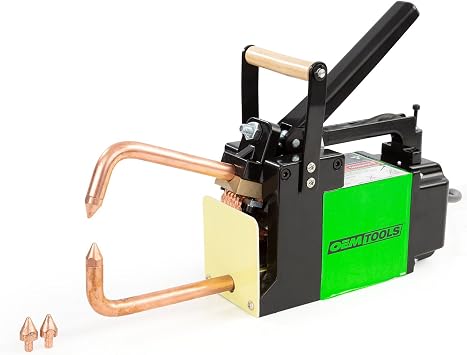
What Happens if You Under-Provision or Over-Buy Power Output?
Under-provisioning occurs when the spot welder’s power output is too low to generate enough heat to fuse the metal in the required timeframe. If a spot welder provides less than the necessary kW for your specific nickel thickness, the result is a “cold” weld. These welds lack structural integrity because the metal atoms have not fully bonded, causing the nickel strip to peel away under the mechanical stress of a battery pack. This is a primary failure mode that can lead to high resistance and potential overheating during use.
Risks of Low Power Output
When a spot welder lacks the necessary power, users often attempt to compensate by increasing the pulse duration or the number of pulses. This creates a risk of excessive heat soak. Because the welder is struggling to penetrate the metal, the heat lingers in the area, potentially damaging the internal chemistry of the lithium cells or causing them to enter thermal runaway. A welder with insufficient power often forces a trade-off between a weak weld and a damaged battery.
Over-buying power output involves purchasing a machine with significantly higher kW than your project requires. While it might seem like a safer choice, high-power units often require more robust infrastructure. A high-output spot welder may demand a dedicated high-voltage circuit or a specialized cooling system that a standard home workshop cannot provide. Furthermore, a machine with excessive power can make it difficult to achieve precision on very thin materials, as the energy may be too intense to control, leading to burnt spots or melted nickel.
For those needing a compact setup, explore our comparison of the best portable spot welder for hobbyists.
The Practical Costs of Over-Buying
The primary cost of over-buying is the unnecessary expenditure on hardware that your specific application cannot utilize. If you are only welding 0.1mm nickel strips for small electronics, a 5 kW industrial machine provides no functional advantage over a 1.5 kW unit. You pay a premium for heavy-duty components, larger capacitors, and more complex cooling systems that remain idle during your work. In many cases, the weight and footprint of an over-specified machine also make it less practical for a workshop environment.
The Common Mistake with Power Output and What to Optimize Instead
The most common mistake buyers make is assuming that a higher kW rating automatically translates to a better weld. While power is a component of the equation, it is not the only variable that determines the success of a spot weld. Many users focus solely on the kW figure while ignoring the pulse characteristics of the machine.
Prioritizing Pulse Control Over Raw Power
Instead of just looking for the highest power output, buyers should optimize for pulse duration and current consistency. A spot welder that can deliver a precise, high-amperage burst for a millisecond is often more effective than a unit that provides a slower, less controlled flow of energy. Pulse control allows for the “snap” required to fuse metal without the “soak” that damages batteries. When selecting a machine, the ability to adjust the pulse width and frequency is often more critical for reliability than the maximum peak power rating.
How Power Output Interacts with Other Deciding Specs
Power output does not exist in a vacuum; its effectiveness is limited by the physical properties of the materials being joined. The thickness of the nickel strip is the most immediate constraint on how much power is actually useful. A spot welder with 5 kW of power cannot produce a better weld on 0.1mm nickel than a 1 kW welder can; both have reached the point of saturation where the metal is fully fused.
The Nickel Thickness Ceiling
The thickness of the nickel strip defines the maximum material the welder can penetrate without melting the strip entirely. If your project uses nickel thinner than 0.1mm, a high-power machine is unnecessary. If your project requires nickel thicker than 0.3mm, you must ensure the welder’s power output is high enough to reach the required depth. The material’s thickness determines the “ceiling” of the machine’s utility.
Capacitor Bank and Discharge Limits
For portable spot welders, the power output is directly tied to the capacity of the internal capacitor bank. A high kW rating is only useful if the capacitor bank can deliver that energy in the required burst. If the capacitor bank is too small, the machine will “sag” during the weld, resulting in a weak connection regardless of the stated maximum power. Buyers should ensure the capacitor bank is rated for the high-current pulses required for their specific nickel thickness, as the capacitor’s ability to discharge quickly is what creates the weld.
The Role of Tip Condition
Even a high-power welder will produce inconsistent results if the welding tips are oxidized. Tip oxidation increases electrical resistance, which can cause the weld to burn or the power to be distributed unevenly. Because the power output is concentrated at the point of contact, maintaining clean, high-conductivity tips is just as important as the kW rating of the machine. A lower-powered machine with clean tips will often outperform a high-powered machine with degraded tips.