
When evaluating a spot welder, you must distinguish between load-bearing technical specifications and marketing vocabulary. Terms like “professional-grade” or “advanced” provide no measurable data regarding the machine’s output. Instead, focus on measurable metrics: the energy capacity of the capacitor bank, the thickness of the nickel strip the unit can penetrate, and the welding method used. These figures dictate whether a machine can handle a standard 18650 battery pack or if it will produce a “cold” weld that fails under load. Ignore the adjectives and prioritize the numbers.
Spot Welder Capability and Performance Terms
- Capacitor Bank (mF/μF) – This measures the energy storage capacity of the unit. A higher value allows for higher-current pulses, which are necessary for welding thicker nickel strips or larger battery cells.
- Pulse Welding – This is the standard method for portable units where electricity is delivered in a millisecond burst. It prevents the lithium cells from overheating by applying heat only at the point of contact, unlike continuous wave welding which can cause thermal runaway.
- Nickel Strip Thickness (mm/mil) – This is the maximum thickness of metal the welder can successfully penetrate. For most hobbyist applications, a welder capable of 0.2mm to 0.3mm is the standard requirement; anything less may result in a weak weld.
- Pulse Duration (ms) – This is the length of time the electricity flows during a single weld. Shorter, faster pulses are generally better for thin nickel strips to prevent the metal from melting away before the weld sets.
- Resistance Spot Welding – This refers to the mechanical process of joining two pieces of metal by applying pressure and heat. In this category, it distinguishes the tool from a MIG or TIG welder, which use wire or rods.
- Output Current (Amps) – This measures the amperage delivered during the pulse. Higher amperage allows for deeper penetration into the nickel, but it must be balanced with pulse duration to avoid damaging the battery’s internal chemistry.
Where these choices show up in our reviews
These 3 have their own full review on this site, and run from $159.99 to $182.98.

GLITTER 801B Battery Spot Welder
$165 price checked August 2026
If you are just starting out, see our comparison of the best battery spot welder for DIY projects.
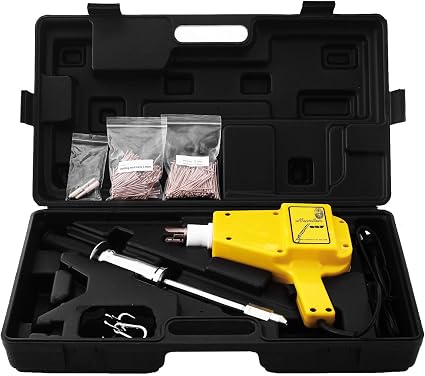
Mophorn 4550 Stud Welder Starter Kit
$182.98 price checked August 2026
For those needing mobility, explore the best portable spot welder for hobbyists.
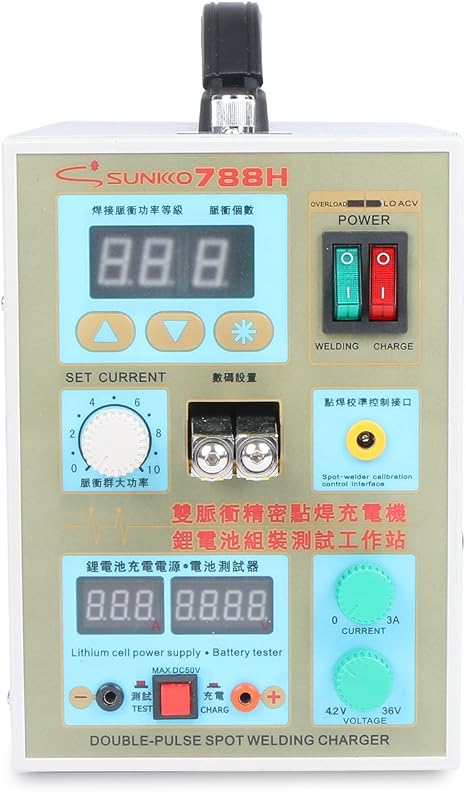
SUNKKO Pulse Spot Welder 788H
You can also learn about the different types of spot welders available on the market.
$159.99 price checked August 2026
Spot Welder Physical and Build Specifications
- Tip Material – This refers to the metal used on the welding heads, often copper or copper-plated steel. High-quality tips maintain a consistent surface and resist oxidation, which is the primary cause of inconsistent weld quality.
- Tip Diameter – This is the width of the welding point. A smaller diameter provides a more concentrated weld for small cells, while a larger diameter is used for heavy-duty connections.
- Weight (kg/lbs) – This indicates the portability of the unit. Because capacitor-based welders rely on internal components rather than large external power supplies, a lower weight usually indicates a more compact, portable design.
- Heat Sink Surface Area – This is the physical area designed to dissipate heat from the welding heads. Better heat dissipation prevents the tips from becoming too hot to handle between welds.
- Cable Length – This is the distance between the handle and the welding head. Longer cables provide more freedom of movement but can introduce resistance if the wire gauge is too thin.
Spot Welder Compatibility and Standards
- 18650/21700 Compatibility – These are the standard lithium-ion cell sizes. A welder suitable for these cells must provide enough pulse energy to penetrate the nickel strip without causing “heat soak” into the battery’s internal chemistry.
- Nickel Strip Grade – This refers to the purity of the metal being welded, such as 0.1mm to 0.3mm nickel strip. The welder must be rated to handle the specific gauge of nickel you intend to use.
- Voltage Input (V) – This is the power requirement for the welder’s charging system. Most portable units operate on standard household voltage, but the charging time for the internal capacitor bank varies based on this rating.
- Cooling Method – This describes how the unit manages heat during operation. Some units use passive cooling (heat sinks), while others may use active cooling (fans) to keep the internal electronics stable.
Commonly Confused Spot Welder Terms
Pulse Welding vs. Continuous Wave
Pulse welding delivers a high-current burst in milliseconds, whereas continuous wave welding provides a steady flow of electricity. For lithium battery work, pulse welding is the required standard because it prevents the battery from reaching dangerous temperatures during the welding process.
To understand the mechanics, view how a spot welder works in our basic overview.
Cold Welds vs. Heat Soak
A “cold” weld occurs when the welder lacks sufficient amperage or pulse duration to fuse the metal, resulting in a weld that looks attached but peels off under load. “Heat soak” is the opposite problem, where the weld stays too long, allowing heat to travel into the battery and potentially cause a failure.
Capacitor Bank vs. Power Supply
A capacitor-based welder stores energy in a bank to release it in a burst, making it portable and battery-operated. A power supply welder (like an industrial AC-powered resistance spot welder) draws power directly from a wall outlet, allowing for much higher weld depths and structural integrity at the cost of portability.
Safety and Technical Limits
The primary safety limit in spot welding is the heat and resistance of the weld. A high-resistance “cold” weld creates a point of failure where the nickel strip can peel off under load, potentially causing a short circuit. Conversely, excessive heat soak can cause the internal chemistry of the lithium battery to degrade or enter thermal runaway. Buyers should confirm that the welder’s pulse settings are appropriate for the specific gauge of nickel and cell chemistry being used before beginning work.