
Temperature range in a pro convection oven defines the maximum and minimum heat levels the heating elements can maintain. Your specific requirements for food types, cooking methods, and desired textures determine which temperature range you need to select.
Which Temperature Range Suits Your Needs?
| If this is you | The Temperature Range that suits you | Why |
|---|---|---|
| You primarily bake delicate pastries, macarons, or meringues. | Low-range precision (150°F – 350°F) | Lower temperatures require stable, consistent heat to prevent over-browning while the interior sets. |
| You bake standard bread, cookies, and roasted vegetables. | Standard range (150°F – 450°F) | This range covers the vast majority of home and small-batch commercial baking requirements. |
| You roast meats or perform high-heat searing and “flash” baking. | High-range capability (up to 500°F or 550°F) | Higher limits allow for the Maillard reaction and crust development on proteins without burning the exterior. |
| You operate a high-volume bakery requiring heavy-duty roasting. | Extended high-heat (up to 600°F) | Industrial-scale roasting of nuts or specific large-batch items requires limits beyond standard convection ovens. |
Pro Convection Ovens covered by our own reviews
From $309.90 to $549: the 3 in this category we have reviewed in full.

Avantco CO-16 Half Size Countertop Convection Oven
$549 price checked August 2026
Read our full Avantco CO-16 review
If you have limited space, explore the best countertop convection oven for small kitchens.
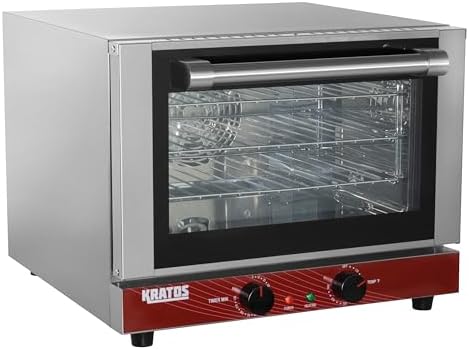
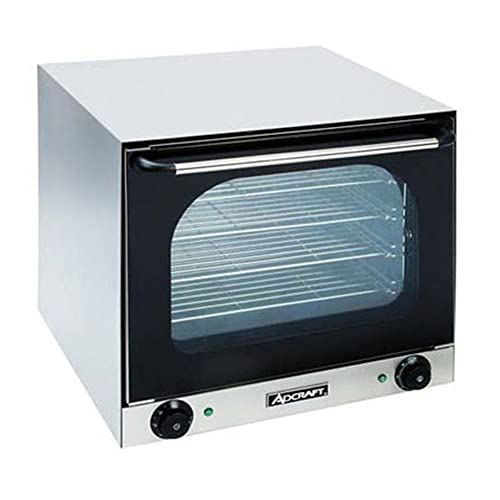
Adcraft COH-2670W Half-Size Electric Countertop Convection Oven
$549 price checked August 2026
You should also consider how interior width affects convection oven capacity.
How Do I Establish My Required Temperature Range?
You establish your required temperature range by identifying the highest and lowest heat settings used in your specific recipes. Most professional convection ovens list their operating range in the manufacturer’s technical specifications, usually found on a sticker inside the door or on the back panel.
Audit Your Current Recipe Requirements
Review the recipes you plan to cook most frequently and highlight the required oven temperatures. If your most frequent items require 425°F, you must ensure the oven’s maximum rating exceeds this number by at least 25°F to account for heat fluctuations. Identify the lowest temperature needed for slow-roasting or proofing, as some ovens may struggle to maintain steady heat below 150°F.
Verify the Manufacturer’s Rated Range
When looking at specifications, verify the maximum temperature the unit can sustain for extended periods. Some ovens may reach a high temperature briefly but cannot maintain it for a full roasting cycle. Confirm that the range covers your highest required point and your lowest required point without reaching the absolute limits of the machine’s hardware.
What Happens if the Temperature Range is Incorrect?
Choosing a temperature range that is too low or too high results in specific failures during the cooking process. Each direction of error impacts the final product differently based on heat transfer physics.
Make sure to research selecting the correct voltage for convection ovens before purchasing.
Risks of a Range That Is Too Low
If the oven cannot reach the required temperature, you will experience insufficient browning and “doughy” centers. For example, a roast that requires 400°F to develop a crust will remain grey and moist if the oven maxes out at 350°F. This occurs because the heat energy is insufficient to trigger the rapid moisture evaporation required for a crisp exterior.
Risks of a Range That Is Too High
A temperature range that exceeds your needs is not a failure of the oven, but choosing a unit that lacks precision at the lower end can cause issues. If an oven is designed primarily for high-heat roasting, it may have wide temperature swings. This leads to scorched edges on delicate items like biscuits or cookies because the heating elements cycle on and off too aggressively at lower settings.
What Should I Do if I Fall Between Two Ranges?
If your requirements sit on the border between two common temperature ranges, you should prioritize the upper limit of your needs. It is easier to cook at a lower temperature than it is to cook at a higher temperature than the oven is rated for.
Prioritize the Upper Bound
If your recipes frequently call for 450°F but the oven is rated for 425°F, the oven will fail to produce the desired results. If your recipes call for 400°F and the oven is rated for 450°F, you can safely operate the oven at 400°F. Therefore, always select a range where the maximum rated temperature is comfortably above your highest required cooking point.
Consider Temperature Stability
When choosing between two ovens that both meet your maximum temperature needs, look at the smallest increment the oven can move. A unit that can adjust in 5°F increments provides better control for delicate baking than a unit that only moves in 25°F increments. Precision at the lower end of the range is often more important for pastry work than high-heat capability is for roasting.
The other Pro Convection Oven guides we have published
- Countertop Convection Ovens for Large Sheet Pans Compared
- Choosing the Best Countertop Convection Oven with Digital Controls
- The Pro Convection Ovens That Work Best for Baking
- Commercial Countertop Convection Ovens for Pizza Baking Compared
- Choosing the Best Half Size Countertop Convection Oven
- The Quarter Size Countertop Convection Ovens That Work Best for Small Spaces