
Convection Oven Terms and Specs, Explained in Plain English
When evaluating pro convection ovens, most technical specifications are load-bearing indicators of how much work the machine can do. High-wattage ratings, internal volume measurements, and specific airflow standards determine whether the unit can handle a commercial production workflow or is limited to home use. Conversely, many marketing terms like “blazing fast,” “professional-grade,” or “innovative” are non-functional descriptors that do not change the physical capabilities of the hardware. You should focus on the numbers—wattage, cubic feet, and voltage—to determine if the oven meets your production requirements.
Where these choices show up in our reviews
These 3 have their own full review on this site, and run from $309.90 to $2080.
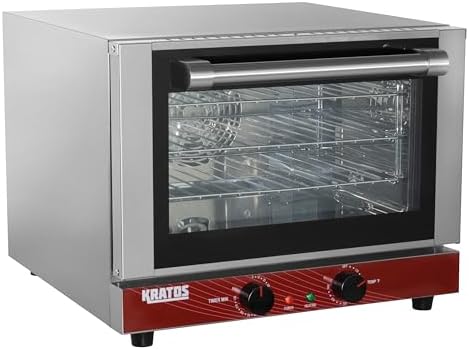
Kratos 29M-001 Quarter Size Electric Countertop Oven
$309.90 price checked August 2026
If you need a compact footprint, compare the best half size countertop convection oven options for your space.
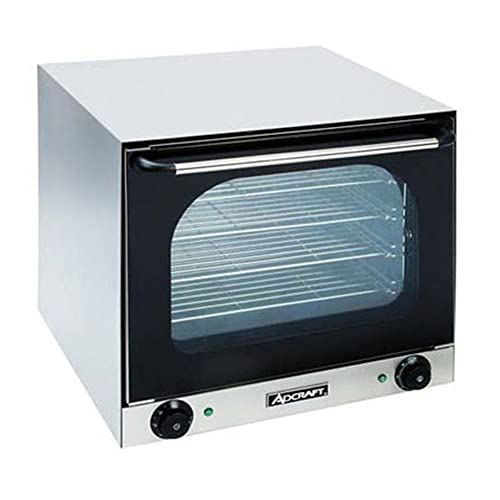
Adcraft COH-2670W Half-Size Electric Countertop Convection Oven
$549 price checked August 2026
Understanding your specific needs starts with learning about the different types of convection ovens available today.
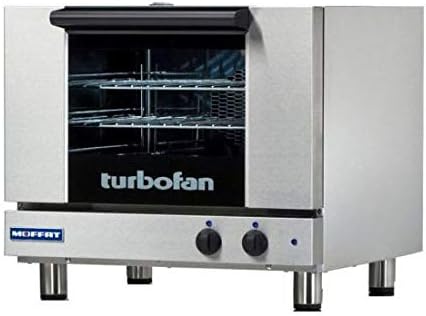
Moffat E22M3 24″ Countertop Convection Oven
$2080 price checked August 2026
For a deeper dive into the science, see how a convection oven works to understand its heat distribution.
Power and Capacity Specs for Convection Ovens
- Wattage – This measures the electrical power consumed by the oven; higher wattage generally allows the oven to recover its target temperature faster after the door is opened or a cold product is inserted.
- Voltage (120V vs 240V) – This specifies the electrical requirement of the unit; 240V is a standard threshold for high-wattage commercial ovens that require a dedicated circuit to power large heating elements.
- Interior Volume (Cu. Ft.) – This measures the internal space available for cooking; a minimum of 1.5 Cu. Ft. is the standard required to hold a standard half-size sheet pan.
- Heating Element Type – This refers to the hardware providing the heat, such as upper, lower, or side elements; having multiple elements allows for more consistent heat distribution across different rack levels.
- Convection Fan Speed – This indicates how quickly the internal fan circulates air; a variable speed range allows for different cooking styles, from slow-roasting to high-velocity baking.
- Max Temperature – This is the highest heat setting the oven can reach; for most commercial baking, a range that reaches at least 450°F is necessary for high-heat applications.
Airflow and Control Specs for Convection Ovens
- Convection Airflow Pattern – This describes how air moves, such as “top-down” or “bottom-up”; different patterns affect how moisture is stripped from the surface of the food.
- Humidity Control – This indicates if the oven can inject steam or maintain moisture; higher humidity control is better for breads and pastries that require a moist environment during the initial bake.
- Temperature Recovery Time – This is the time it takes for the oven to return to the set temperature after a door opening; a shorter recovery time is a critical metric for high-volume production.
- Digital PID Controller – This is a type of electronic thermostat that maintains precise temperature stability; a PID controller is superior to a standard mechanical thermostat for consistent results.
- Timer Accuracy – This measures the precision of the countdown; for professional workflows, a digital timer that tracks down to the minute is preferred over analog dials.
- Multi-Rack Cooking – This refers to the ability to cook on multiple levels simultaneously; ovens designed for this feature have specific fan placements to prevent “cold spots” on lower racks.
Physical and Build Specs for Convection Ovens
- Exterior Dimensions – This lists the width, depth, and height of the unit; you must confirm these measurements against your workspace before ordering to ensure the oven fits through doorways and into your designated area.
- Weight Capacity – This specifies the maximum weight the internal racks can hold; a higher weight rating ensures the shelves will not sag or buckle under heavy trays of dough or meat.
- Door Swing Clearance – This indicates the amount of space required to open the door fully; you need to measure your workspace to ensure the door does not hit walls or other equipment when opened.
- Material Grade (e.g., 18/10 Stainless Steel) – This specifies the composition of the exterior and interior surfaces; 18/10 is a high-quality standard for corrosion resistance and durability in commercial kitchens.
- NSF Certification – This is a standard for food safety and sanitation; an NSF-certified unit meets the baseline requirements for commercial kitchen environments.
Commonly Confused Convection Oven Terms
Understanding the difference between specific technical terms prevents ordering a unit that cannot perform the required task.
- Convection vs. Conventional – A conventional oven relies on stationary heating elements and natural air rise, while a convection oven uses a fan to circulate hot air; convection results in faster cooking and more even browning.
- Convection vs. Combi Ovens – A convection oven uses only hot air, whereas a “combi” oven can inject steam into the cooking process; you only need a combi oven if your workflow specifically requires high-humidity steam cooking.
- Countertop vs. Reach-In – A countertop oven sits on a surface and is limited by its physical footprint, while a reach-in oven is a large, floor-standing unit; reach-in ovens offer significantly higher volume and higher-wattage heating elements.
- Wattage vs. BTUs – Wattage is the standard for electric ovens, while BTUs measure the heat output of gas-powered ovens; you must match the power source of your facility to the correct measurement type.
Browse our other Pro Convection Oven pages
- Commercial Countertop Convection Ovens for Pizza Baking Compared
- Choosing the Best Half Size Countertop Convection Oven
- The Quarter Size Countertop Convection Ovens That Work Best for Small Spaces
- Which Countertop Convection Oven Is Best for Small Kitchens?
- Best Mid-Range Professional Countertop Convection Ovens for Restaurants
- Countertop Convection Ovens for Large Sheet Pans Compared