
A pro convection oven is a commercial-grade cooking appliance that uses fans to circulate hot air around food during the cooking process. Unlike a standard oven that relies primarily on radiant heat from the top and bottom elements, a convection oven ensures that heat is distributed evenly throughout the internal chamber. This technology allows for faster cooking times and more consistent results, making it a standard tool for high-volume baking and roasting.
The primary problem this category solves is the inconsistency of heat distribution in large-capacity ovens. In a traditional oven, the air near the heating elements becomes significantly hotter than the air in the center or at the corners of the chamber. This often results in “hot spots” where the edges of a tray scorch while the center remains undercooked. By moving the air, a convection oven eliminates these temperature pockets, allowing you to cook multiple trays at once without the risk of uneven results.
How does a pro convection oven work?
A pro convection oven works by creating a constant flow of heated air to strip away the “boundary layer” of cooler air that naturally surrounds hot food. This process follows a specific mechanical sequence:
- The heating elements (usually located at the top and bottom) generate heat to raise the internal temperature of the oven chamber.
- A high-powered fan, often positioned at the rear or side of the unit, pulls the air across the heating elements.
- The fan pushes this heated air through a series of vents or across a perforated back wall to distribute it throughout the interior.
- The moving air strikes the surface of the food, transferring heat more rapidly and evenly than still air can.
- The constant circulation prevents heat from pooling in one area, ensuring that the temperature remains uniform even as the oven door is opened or new products are inserted.
Pro Convection Ovens we have reviewed in detail
Prices across these 3 run from $309.90 to $549; each one has a full review here.


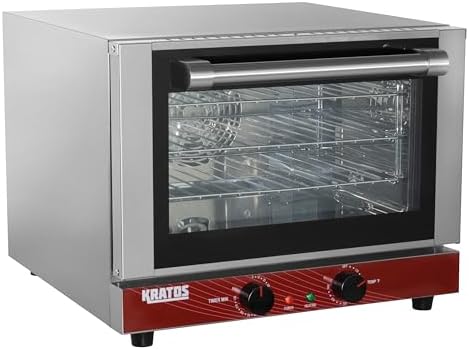
Kratos 29M-001 Quarter Size Electric Countertop Oven
$309.90 price checked August 2026
You can learn common convection oven terms and specs to better understand the technical data sheets of these units.
Parts and stages that matter to a buyer
Understanding the specific components of a pro convection oven helps determine how the unit will perform under heavy use. Each component directly impacts the speed and quality of the output.
Fan speed and airflow
Fan speed determines the velocity of the air moving across the food. High-velocity fans are essential for roasting meats or large batches of cookies where rapid surface browning is required. If the fan is too slow, the oven behaves more like a standard radiant oven; if it is too fast, it can cause delicate items like soufflés to collapse or dry out prematurely.
Wattage and power source
Wattage determines the oven’s ability to maintain its set temperature when the door is opened or when a cold, heavy tray is inserted. In a commercial setting, a low-wattage unit may struggle to recover its temperature quickly enough to keep the cooking timeline consistent. Many professional units require a 240V power connection to reach the high-wattage thresholds necessary for full-size pan capacity.
Chamber volume and dimensions
Chamber volume dictates the maximum footprint of the items you can cook. For professional workflows, the internal dimensions must be large enough to accommodate standard sheet pans. A common mistake is selecting a unit that fits a standard tray but cannot accommodate a half-size or full-size sheet pan, which limits the production capacity of the kitchen.
Interior lining and construction
The material of the interior walls, such as 18/10 stainless steel, affects heat retention and ease of cleaning. Stainless steel is the industry standard because it can withstand repeated high-heat cycles and harsh cleaning agents without corroding or warping, ensuring the oven maintains its structural integrity over years of use.
What having a pro convection oven changes in practice
Having a pro convection oven changes the consistency of the output, particularly when cooking large batches or multiple trays simultaneously. In a professional kitchen, this means you can roast three trays of chicken at the same time and expect each piece to have the same level of doneness. In a home setting, it means cookies will have a uniform golden color rather than some being pale and others burnt.
The difference is most noticeable in high-moisture applications. Because the moving air evaporates surface moisture more quickly, convection ovens are superior for achieving a crisp exterior on bread or roasted vegetables. However, the difference is less pronounced in slow-cooking applications, such as braising, where the goal is to keep the food submerged in liquid rather than exposed to moving air.
A convection oven also changes the required cooking time. Because heat is transferred more efficiently, most recipes require a reduction in temperature—often by 25°F (around 14°C)—and a shorter cooking duration compared to a standard oven. Failing to adjust the temperature is a common mistake that leads to overcooked food.
Who needs a pro convection oven?
You need a pro convection oven if your workflow requires consistent results across large volumes of food or if you frequently bake items that require a crisp, even exterior. This includes bakeries producing large quantities of cookies, catering operations roasting multiple proteins at once, or any environment where the “hot spot” variability of a standard oven creates a risk of wasted product.
You do not need a pro convection oven if you primarily cook small portions of food or if your recipes rely on moist, slow-cooked methods like braising or steaming. If you rarely cook more than one tray of food at a time, the added complexity and cost of a convection system may not provide a measurable improvement over a standard home oven.
The other Pro Convection Oven guides we have published
- Commercial Countertop Convection Ovens for Pizza Baking Compared
- Choosing the Best Half Size Countertop Convection Oven
- The Quarter Size Countertop Convection Ovens That Work Best for Small Spaces
- Which Countertop Convection Oven Is Best for Small Kitchens?
- Best Mid-Range Professional Countertop Convection Ovens for Restaurants
- Countertop Convection Ovens for Large Sheet Pans Compared