
What is Blade Count in Kitchen Cutlery?
Blade count is the total number of individual knives included in a kitchen cutlery set, expressed in pcs.
The specific number of pcs you need depends entirely on your cooking frequency, the variety of ingredients you prepare, and your available storage space.
Kitchen Cutlery covered by our own reviews
Prices across these 3 run from $143.99 to $271.99; each one has a full review here.
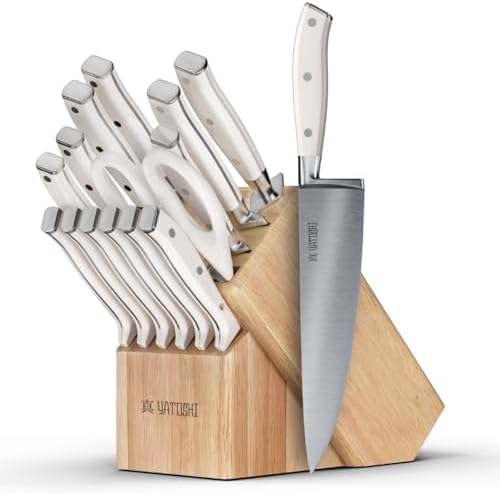
Yatoshi White Knife Block Set
$143.99 price checked August 2026
Read our full Yatoshi Knife Set review
If you are hosting a large event, see our guide to the best disposable cutlery set for parties.


MSY BIGSUNNY 17-piece Knife Block Set
For those seeking high-end aesthetics, explore our comparison of the best damascus kitchen knife set.
$271.99 price checked August 2026
Which Blade Count suits your needs?
| If this is you | The Blade Count that suits you | Why |
|---|---|---|
| You only cook simple meals like sandwiches, basic salads, or occasional roasted vegetables. | 3 to 5 pcs | A small selection covers the essentials: a chef’s knife, a paring knife, and perhaps a serrated blade for bread. |
| You cook for a family of three or more and prepare a variety of proteins and vegetables daily. | 7 to 10 pcs | This range provides specialized tools like a bread knife, a utility knife, and a santoku, allowing for more efficient prep work. |
| You are a dedicated home cook who enjoys complex recipes, heavy butchery, or specialized pastry work. | 12 to 15+ pcs | High-count sets include specialized blades like boning knives, filleting knives, and large carving knives for diverse tasks. |
| You have very limited counter space or a small apartment kitchen with minimal drawer room. | 3 to 5 pcs | A minimal count reduces clutter and ensures you have the high-quality tools you use most often without overcrowding your workspace. |
How do I establish my required Blade Count before ordering?
To establish your required blade count, you must audit your current cooking habits and identify the specific tasks you perform most frequently.
Identify your core tasks
Start by listing the three types of food you prepare most often. If you primarily cut vegetables, a single high-quality chef’s knife might suffice. If you frequently handle different types of meat, fish, and bread, your required blade count will naturally increase to accommodate specialized edges.
Check your current kitchen inventory
Look at the knives you already own and identify which ones you reach for every time you cook. If you find yourself constantly trying to use a small paring knife to cut a large piece of meat, or using a dull bread knife to slice vegetables, you have identified a gap in your current set that a higher blade count could fill.
Understanding the blade count is only half the process; you should also learn how to choose the right blade length.
Locate the count on product listings
When researching options, the blade count is usually listed as a numerical value followed by “pcs” or “pieces.” This number is typically found in the main product title or the primary technical specifications list. Ensure the number represents the total number of blades, not the number of included accessories like sharpeners or knife blocks.
Assess your storage capacity
Measure the available space in your knife block or drawer. A set with a high blade count requires physical space for storage. If you do not have the room to store 15 pcs, a larger set will likely end up in a box in the cupboard rather than being used in your daily routine.
What happens if I choose a Blade Count that is too low?
Choosing a blade count that is too low results in “tool compromise,” where you are forced to use a knife for a task it was not designed to handle.
Edge damage from improper use
When you have a low blade count, you may attempt to use a standard chef’s knife to cut through hard crusty bread or to de-bone poultry. Because these tasks require different geometries, using the wrong tool can lead to micro-chipping or rolling of the edge. This happens because the blade’s thickness or curve is not suited for the resistance of the material.
Reduced efficiency and prep time
A low blade count forces you to perform multiple steps with a single tool. For example, using a large chef’s knife to peel small fruits is inefficient and can be less precise than using a dedicated paring knife. This lack of specialization slows down your preparation time and can make complex tasks more frustrating.
What happens if I choose a Blade Count that is too high?
Choosing a blade count that is too high leads to “tool redundancy,” where you own multiple blades that perform nearly identical functions.
Balance is another critical factor, so view our guide on selecting the proper blade weight.
Cluttered workspace and storage issues
A high blade count requires significant storage space. If you have more knives than you have room to organize, they can become difficult to access quickly. This clutter can make the cooking environment feel cramped and disorganized, potentially leading to you ignoring the extra tools entirely.
The “analysis paralysis” of choice
Having too many options can make it harder to decide which tool is right for a specific task. When you have five different knives that all perform similar slicing actions, you may spend more time searching for the “right” one than actually preparing your food. This redundancy often results in several blades remaining unused for months at a time.
What should I do if I fall between two Blade Count values?
If your needs fall between two values, such as deciding between a 7 pcs set and a 10 pcs set, you should prioritize the specific “gap” tool that would most improve your workflow.
Identify the “missing” tool
Instead of looking at the total number, look at the specific types of knives included in each option. If the 10 pcs set includes a serrated bread knife and a utility knife that you currently lack, that set is the better choice for your specific needs. If the 10 pcs set simply adds three more versions of a knife you already own, stay with the lower count.
Choose based on growth potential
If you are a beginner who intends to learn more advanced techniques over the next year, it is often better to choose the higher blade count. Having the specialized tools available as you develop your skills prevents you from having to purchase individual knives later. However, if your cooking habits are unlikely to change, the lower count remains the more practical choice to avoid unnecessary clutter.
The other Kitchen Cutlery guides we have published
- Best Entry-Level Japanese Kitchen Knife Sets
- Kitchen Knife Sets for Home Cooks Compared
- Choosing the Best Disposable Cutlery Set for Parties
- Best Damascus Kitchen Knife Sets for Home Cooking
- Japanese Kitchen Knife Sets for Precise Food Prep Compared
- Choosing the Best Kitchen Knife Set with Block for Home Cooking