
Wire Diameter refers to the thickness of the welding wire fed through a gas metal arc welder, measured in inches (in.). The specific diameter you need depends entirely on the thickness of the metal you intend to weld and the penetration depth required for your specific project.
Which Wire Diameter suits my project?
| If this is you | The Wire Diameter that suits you | Why |
|---|---|---|
| You are performing light fabrication on thin sheet metal (under 1/8-inch) or decorative work. | 0.023 in. to 0.030 in. | Thinner wire allows for a smaller weld pool and precise control on thin materials without blowing through the metal. |
| You are a hobbyist working on general repairs, furniture, or automotive brackets (1/8-inch to 3/16-inch). | 0.030 in. to 0.035 in. | This range is the standard for most general-purpose MIG welding, providing a balance of feed speed and penetration. |
| You are working on structural steel, heavy machinery, or thick plates (3/16-inch to 1/4-inch). | 0.035 in. to 0.045 in. | Heavier wire provides the necessary deposition rate and heat to penetrate thicker materials effectively. |
| You are performing heavy industrial fabrication or welding thick structural beams (over 1/4-inch). | 0.045 in. to 0.050 in. | Large diameter wire is required to provide sufficient metal volume and deep penetration for heavy-duty applications. |
Reviewed examples from this category
These 3 have their own full review on this site, and run from $104.99 to $224.90.
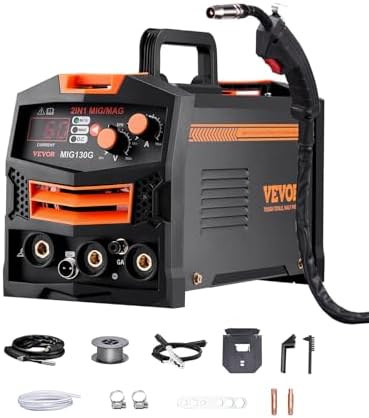

hynade MTG155D Dual Voltage Mig Welder
$105.99 price checked August 2026
If you are working in a confined area, compare the best portable MIG welder for small spaces to find the right size.

How do I determine the correct Wire Diameter before I buy?
Determining the correct Wire Diameter begins with identifying the thickness of the base material you plan to join. You should measure your workpiece using a caliper or a standard ruler to establish the exact thickness in inches.
Matching thickness to diameter
For materials thinner than 1/8-inch, a wire diameter of 0.030 in. is often the upper limit for clean results. If you are welding materials between 1/8-inch and 3/16-inch, 0.035 in. wire is the most common choice because it balances ease of use with sufficient penetration. For materials 3/16-inch and thicker, you should look toward 0.045 in. wire to ensure the weld achieves the required depth.
Understanding your power source is vital, so learn how to choose input voltage for MIG welders before purchasing.
Where to find the diameter on the spool
When you receive a spool of welding wire, the diameter is almost always printed directly on the side of the plastic reel or on the paper core. Look for a measurement followed by “in.” (inches). For example, a spool may be labeled “0.035 in. ER70S-6”. The “0.035 in.” identifies the thickness, while “ER70S-6” refers to the chemical composition and mechanical properties of the wire.
What happens if I choose the wrong Wire Diameter?
Choosing a Wire Diameter that is too small or too large for your material will result in visible defects and structural weaknesses in the weld.
Consequences of using a wire diameter that is too small
If you use a wire diameter that is too small for the thickness of the metal, the welder will struggle to provide enough heat and filler material. This often results in “cold” welds where the weld bead sits on top of the metal rather than fusing into it. You may notice the wire “stubbing” or burning out before the joint is filled, leading to poor penetration and a high risk of the weld cracking under stress.
Consequences of using a wire diameter that is too large
Using a wire diameter that is too large for thin material causes the welder to deposit too much heat and metal too quickly. This often leads to “burn-through,” where the wire melts entirely through the workpiece, creating a hole. Additionally, a wire that is too large for the intended job can cause the wire feed system to struggle, leading to frequent wire feed jams or an inconsistent arc that creates a messy, oversized bead.
What do I do if my material falls between two Wire Diameter sizes?
When your material thickness falls between two standard wire diameters, you should choose the smaller of the two wire sizes to maintain better control over the weld pool.
Prioritizing control over deposition
It is generally safer to use a slightly smaller wire diameter and adjust your settings to compensate. For example, if your material is right at the 3/16-inch mark, using 0.035 in. wire instead of 0.045 in. wire allows you to maintain a tighter arc and better visibility of the weld puddle. You can achieve the necessary penetration by slightly increasing your voltage or slowing your travel speed.
Compensating for smaller wire diameters
If you choose the smaller wire diameter to handle a borderline thickness, you must ensure your gas metal arc welder is set to the correct wire feed speed for that specific diameter. Using a wire that is smaller than the machine’s primary setting may require you to decrease the feed speed while slightly increasing the voltage to maintain a stable arc. This adjustment ensures that the smaller wire provides enough heat to fuse with the thicker base material without compromising the integrity of the joint.
Where to go next in our Gas Metal Arc Welder coverage
- The Gas Metal Arc Welders That Work Best for Gasless Flux Core Welding
- Which Entry-Level Professional MIG Welder Is Best?
- Choosing the Best MIG Welder for Home DIY Projects
- The 110V MIG Welders That Work Best for Beginners
- Which Budget MIG Welder Is Best for Aluminum?
- Best 3-in-1 MIG Welders for Flux Core and Stick