
There are three meaningfully different types of gas metal arc welders defined by their power source and intended duty cycle. The primary dimension that separates these machines is the power input: whether the unit runs on standard household electricity, a dedicated industrial circuit, or a portable power source. This distinction dictates the thickness of material you can weld, the speed of the process, and the portability of the machine in a work environment.
MIG Welders for Home Use
MIG welders for home use are typically 110V or 220V dual-voltage machines designed for versatility in residential settings. These units allow you to weld using a standard household outlet, making them the primary choice for DIY projects and light fabrication. They are optimized for thin-gauge materials like sheet metal, automotive panels, and furniture frames.
A MIG welder for home use provides the easiest learning curve for beginners because the wire feeds automatically and the heat is consistent. However, these machines have a lower duty cycle, meaning they are not intended for continuous, heavy-duty welding. If you attempt to weld a thick structural beam for long periods, the internal components will overheat and the machine will shut down to protect the circuitry.
In terms of cost, these machines sit at the lower end of the market. They offer the best entry point for someone who needs to perform occasional repairs or small-scale builds but does not have access to a three-phase industrial power supply.
Where these choices show up in our reviews
Prices across these 3 run from $104.99 to $175.98; each one has a full review here.


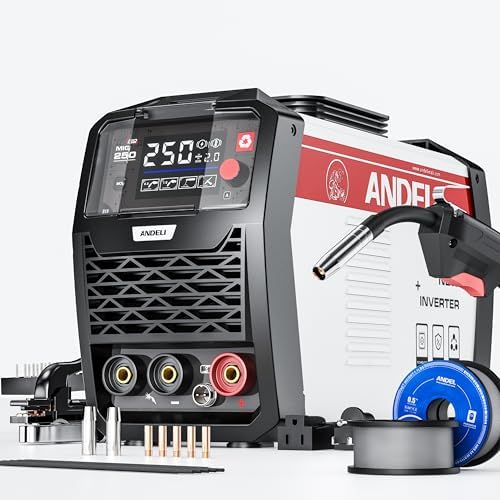
Multi-Process Gas Metal Arc Welders
Multi-process gas metal arc welders combine MIG welding with other methods, such as Stick (SMAW) and Flux Core (FCAW) welding. This type of machine is for the user who needs to switch between different environments, such as welding with gas in a shop and using flux core in an outdoor setting where wind would blow away shielding gas.
Multi-process gas metal arc welders offer the highest level of versatility. They allow you to use a single machine for a wide variety of metals and conditions. The trade-off is that because the internal electronics must accommodate multiple processes, the power output in any single mode may be slightly lower than a dedicated single-process machine of the same physical size.
These machines sit in the mid-range of the price spectrum. They are a practical choice for hobbyists who want to expand their capabilities without buying multiple separate machines for different welding styles.
Industrial MIG Welders
Industrial MIG welders are high-output machines designed for heavy-duty manufacturing, requiring a 220V or 480V three-phase power supply. These machines are built to handle continuous operation on thick materials, such as heavy steel beams, large industrial equipment, and structural components.
Industrial MIG welders provide the highest penetration and the fastest travel speeds for heavy-gauge metal. They are built with heavy-duty cooling systems and high-capacity transformers or advanced inverters to maintain a consistent arc under heavy loads. These machines give up portability; they are often large, heavy units that stay in a fixed location in a factory or large workshop.
These machines sit at the highest price point in the category. They are the standard for professional fabrication shops where downtime is costly and the ability to weld thick plate quickly is a requirement.
Comparison of MIG Welder Types
| Welder Type | Best-Fit Buyer | Main Advantage | Main Compromise |
|---|---|---|---|
| Home/Dual-Voltage | DIYers and hobbyists | Runs on standard outlets | Lower duty cycle/limited thickness |
| Multi-Process | Versatile hobbyists | Multiple welding styles | Lower power per process |
| Industrial | Professional fabricators | High power/heavy-duty use | Limited portability/high cost |
How to Choose the Right MIG Welder Type?
To determine which type of gas metal arc welder fits your needs, you should evaluate the thickness of the material you intend to weld. If you are working primarily with materials thinner than 1/4-inch, a home-use dual-voltage machine is often sufficient for the task.
You should check your available power source before making a decision. If you only have access to a standard 110V wall outlet, a dual-voltage machine is a requirement. If you have a 220V outlet but only do occasional work, a multi-process machine provides the most flexibility for a home shop.
Consider the environment where the welding will occur. If you need to weld outdoors in windy conditions where shielding gas cannot be used, you need a machine that supports Flux Core (FCAW) welding. If you are doing heavy industrial fabrication where the machine must run for hours at a time, you must select an industrial welder capable of handling the required amperage and duty cycle.
Browse our other Gas Metal Arc Welder pages
- Portable MIG Welders for Small Spaces Compared
- Choosing the Best Dual Voltage MIG Welder for 110V and 220V
- The Gas Metal Arc Welders That Work Best for Gasless Flux Core Welding
- Which Entry-Level Professional MIG Welder Is Best?
- Choosing the Best MIG Welder for Home DIY Projects
- The 110V MIG Welders That Work Best for Beginners