
When shopping for a pneumatic nail gun, many listings prioritize marketing adjectives like “industrial-strength” or “high-performance” that offer no measurable data. To make a practical decision, you must ignore these subjective claims and focus on load-bearing specifications. These include specific pressure ratings, nail gauges, and magazine types, which dictate what the tool can actually drive and how much power it requires from your compressor. Understanding these technical benchmarks allows you to determine if a tool meets your project requirements or if you are paying for unnecessary features.
Pneumatic Nail Gun Performance and Capacity Specs
Performance specs define the mechanical limits of what a pneumatic nail gun can accomplish during a work shift.
- PSI (Pounds per Square Inch) – This measures the air pressure required to fire the nail. Most framing and roofing applications require a tool capable of operating at the 120 PSI threshold.
- CFM (Cubic Feet per Minute) – This measures the volume of air the tool consumes. A higher CFM requirement means you need a larger compressor to maintain a consistent firing speed without a pressure drop.
- Nail Gauge (16, 18, 23) – This defines the wire thickness of the nails. A lower gauge number, such as 16, indicates a thicker nail for heavy framing, while a higher number like 23 indicates a thinner nail for trim work.
- Firing Rate – This is the number of nails the tool can drive per minute. A higher number indicates a tool designed for high-volume production, provided your compressor can supply the necessary CFM.
- Depth Adjustment – This refers to the ability to set how far the nail penetrates the material. Proper adjustment prevents “proud” nails that snag surfaces or over-driven nails that split the lumber.
- Nozzle/Nosepiece Clearance – This is the physical space available for the nail to exit the tool. Specific clearance requirements determine if a tool can drive nails into tight corners or through thick headers.
Where these choices show up in our reviews
These 3 have their own full review on this site, and run from $106.38 to $259.
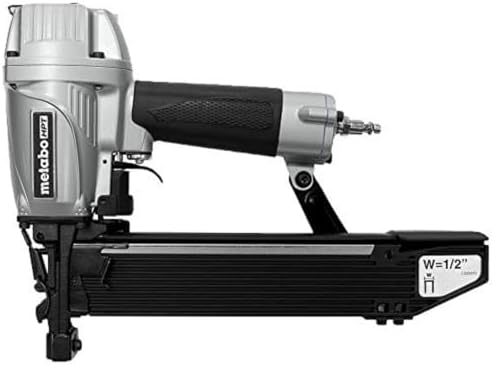
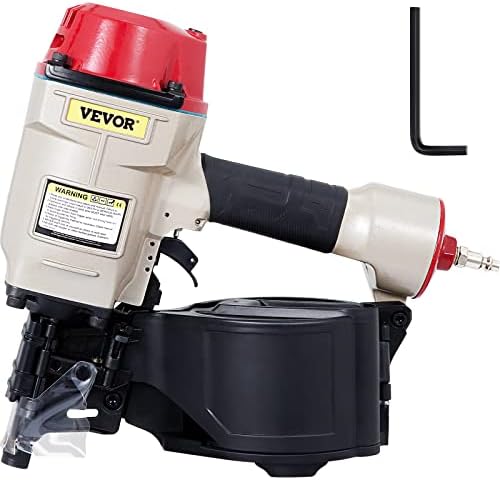
VEVOR Coil Siding Nailer CN70
If you are preparing for a large-scale project, compare the best coil siding nailers for sheathing to find the right fit.
$170.99 price checked August 2026

VEVOR 21 Degree Framing Nailer
$106.38 price checked August 2026
Read our full VEVOR Framing Nailer review
You can also explore the different types of pneumatic nail guns to see which tool matches your specific needs.
Pneumatic Nail Gun Physical and Magazine Types
Physical design terms describe the ergonomics and the way the tool accepts its ammunition.
- Collated Nails – These are nails bundled together in a strip or block. Collated systems are the standard for most framing and roofing, allowing for rapid, continuous firing.
- Strip Nails – A specific type of collation where nails are arranged in a long, continuous row. These are typically used in heavy-duty framing and require a compatible magazine.
- Coil Nails – These are nails arranged in a spiral shape. Coil nails allow for a higher capacity per magazine than strips, making them the standard for high-volume industrial work.
- Magazine Capacity – This is the total number of nails the tool can hold at once. A larger capacity reduces the frequency of reloading during a task.
- Weight – This is the tool’s mass in pounds or kilograms. For overhead work, a lower weight is often a priority to reduce operator fatigue.
- Trigger Pull Weight – This measures the force required to activate the firing mechanism. A lighter pull is generally preferred for repetitive use to prevent hand strain.
Pneumatic Nail Gun Compatibility and Standards
Compatibility terms ensure that the nail gun works with your existing air supply and the specific fasteners you intend to use.
- 15 Degree Angle – This is the standard angle for coil siding nails. Tools designed for this standard have specific magazine geometries to accommodate the nail’s bend.
- 21 Degree Angle – This is the standard angle for framing nails. Tool geometry is built around this angle to ensure the nail enters the wood at the correct trajectory.
- Air Inlet Size – This is the diameter of the hose connection point. You must ensure the tool’s inlet matches your hose and coupler size to prevent leaks or fitting issues.
- Safety Lock/Trigger Lock – This is a mechanical feature that prevents the tool from firing when the trigger is squeezed. This is a standard safety feature for most professional-grade tools.
- Blow-out Port – This is a vent that allows compressed air to escape quickly after firing. A functional blow-out port prevents the nosepiece from becoming obstructed by debris or “jamming.”
Common Pneumatic Nail Gun Confusions
Buyers often confuse several terms that sound similar but result in different tool capabilities or nail requirements.
Gauge vs. Length
Nail gauge and nail length are independent measurements. Gauge refers to the thickness of the wire (with lower numbers being thicker), while length refers to the physical inches of the nail. A tool rated for a 16-gauge nail can often drive various lengths of that gauge, but it cannot drive a 11-gauge nail regardless of length.
CFM vs. PSI
PSI and CFM are often confused because both involve air pressure, but they measure different things. PSI is the “pressure” (how hard the air pushes), while CFM is the “volume” (how much air flows). A tool might require a low PSI but a very high CFM, meaning you need a compressor that can move a large volume of air quickly, even if the pressure is low.
Collated vs. Coil
While both are types of “collated” nails, they refer to different magazine shapes. A strip is a flat row of nails, while a coil is a spiral. A tool designed for strip nails will not accept coil nails because the magazine’s internal feeding mechanism is shaped differently.