
In the spot welder category, safety certifications generally fall into three tiers of utility. Mandatory certifications are those required by law for sale in specific regions, such as CE for the European Economic Area or UL for the United States. Voluntary but meaningful marks, like those from recognized laboratory testing bodies, indicate that a device has undergone specific electrical safety protocols. Decorative marks are those that appear on the chassis or packaging but lack a verifiable registration number or a corresponding standard, often serving only to imply a level of quality that the manufacturer has not officially validated.
What does the CE mark mean for a spot welder?
The CE mark indicates that a spot welder meets the essential health, safety, and environmental protection requirements of the European Union. It is issued by the manufacturer, not by a government agency, meaning the manufacturer takes full legal responsibility for the device’s compliance with directives like the Low Voltage Directive (LVD) and the Electromagnetic Compatibility (EMC) Directive.
The CE mark guarantees that the device is constructed to prevent common electrical hazards, such as short circuits or insulation failures, and that it does not emit excessive electromagnetic interference that could disrupt other electronics. It does not, however, guarantee that the spot welder will produce a high-quality weld or that it can penetrate specific nickel strip thicknesses. Compliance is a baseline for market entry, not a measure of performance.
Where these choices show up in our reviews
From $109.99 to $159.99: the 3 in this category we have reviewed in full.
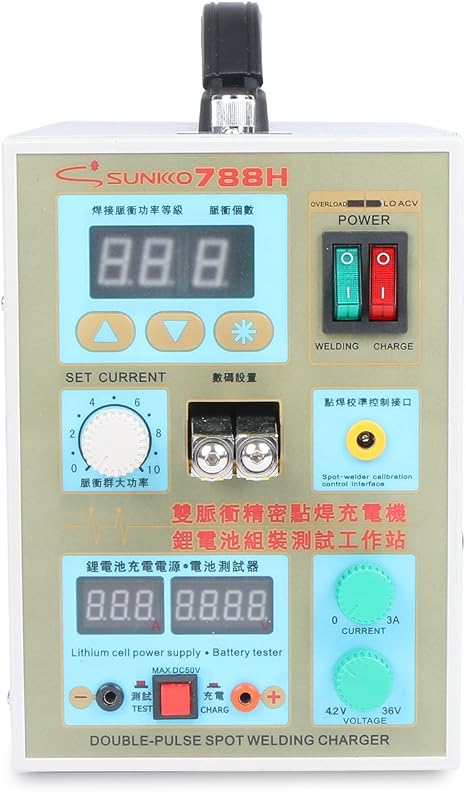

3000F Capacitor Battery Spot Welder
If your project requires structural fastening, compare the best stud welder for auto body repair to see our top picks.
$109.99 price checked August 2026
What is the difference between UL and other safety marks?
Underwriters Laboratories (UL) is a third-party safety science company that provides rigorous testing and certification for products sold in the North American market. A UL listing means the spot welder has been subjected to laboratory testing to ensure it can withstand specific electrical stresses, heat loads, and mechanical stresses without causing fire or electrical shock.
Understanding technical specifications is vital, so learn how to choose pulse duration for spot welders to optimize your results.
A UL listing guarantees that the internal components, wiring, and housing meet strict safety thresholds for heat dissipation and insulation. It does not guarantee the structural integrity of the weld produced by the machine. Because UL testing is rigorous and costly, the presence of a UL mark often indicates a higher level of oversight than a self-certified CE mark.
Which safety failure modes do these standards address?
Safety standards for spot welders primarily address the risk of electrical shock, thermal runaway, and fire hazards caused by excessive heat soak. Because spot welders utilize high-current pulses, the primary risk is a failure in the insulation of the high-voltage components or the cooling system of the capacitor bank.
Electrical shock protection
Standards like the LVD and UL focus on ensuring that the chassis remains isolated from the internal high-voltage circuitry. This prevents the user from receiving a shock if they touch the metal housing while the device is powered on. These standards require specific insulation distances and grounding requirements that are mandatory for any powered welding tool.
Thermal runaway and fire safety
Because spot welders often use capacitor banks to store energy, thermal management is a critical safety factor. Certification standards require that the housing and internal components can withstand the heat generated during rapid-fire pulse welding without melting or igniting. A certified unit must have a design that prevents the internal chemistry of the battery or the capacitor bank from reaching a point of thermal runaway.
How can you verify a safety mark is real?
Verifying a safety mark involves looking past the printed logo on the product’s casing and checking for specific identifiers that can be cross-referenced with the issuing body’s registry.
- Check for a registration number: Most valid certifications, such as CE or UL, include a specific identification number printed near the logo.
- Verify the manufacturer’s documentation: A legitimate seller should be able to provide a “Declaration of Conformity” or a “Certificate of Compliance” upon request.
- Inspect the labels for clarity: Real certifications are usually accompanied by a list of the specific directives or standards the product meets, such as “EN 60950-1” or “UL 62368-1”.
- Cross-reference with the certifying body: For high-end industrial units, you can often enter the manufacturer’s name or the certificate number into the UL or CE database to confirm the status of the listing.
Which marks are non-negotiable for a spot welder?
The non-negotiable marks for a spot welder are those that correspond to your specific geographic region’s legal requirements, such as CE for Europe or UL for North America. If a product is intended for use in a region but lacks the local mandatory safety mark, it may not be legally permitted for sale or could lack the necessary safety protections for your local power grid.
For a reliability-first buyer, a third-party certification from a recognized laboratory is a significant advantage over a self-certified mark. While a self-certified mark meets the minimum legal requirements for sale, a third-party certification provides an additional layer of verification that the device has been physically tested against specific failure modes. You should weigh the presence of a third-party mark against your specific budget, but for high-power units, a recognized safety standard is a primary indicator of a well-engineered tool.