
Most pro convection oven users require between 0.5 Cu. Ft. and 2.0 Cu. Ft. of internal capacity depending on their specific production volume. You must identify your primary tray size and batch frequency to determine which of these volume thresholds fits your workflow.
Recommended Pro Convection Oven Capacity by Use Case
| Use Case | Recommended Capacity | Why This Number Matters |
|---|---|---|
| Small Batch / Home Bakery | 0.5 to 1.0 Cu. Ft. | Provides enough space for a single standard baking sheet or a small stack of cookies. |
| Standard Commercial Bakery | 1.0 to 1.5 Cu. Ft. | The 1.5 Cu. Ft. threshold is the minimum volume required to hold a standard half-size sheet pan comfortably. |
| High-Volume Production | 1.5 to 2.0 Cu. Ft. | Allows for multiple layers of products or full-size pans without crowding the airflow. |
| Specialized Large Batch | Over 2.0 Cu. Ft. | Necessary for large-format baking or heavy-duty production where volume exceeds standard tray sizes. |
Pro Convection Ovens we have reviewed in detail
Prices across these 3 run from $145 to $1392.85; each one has a full review here.

Vollrath 23-7/16″ Half-Size Electric Countertop Convection Oven
$1392.85 price checked August 2026
Read our full Vollrath Countertop Convection Oven review
If you are working with a limited budget, browse the best mid-range professional countertop convection oven for restaurants.
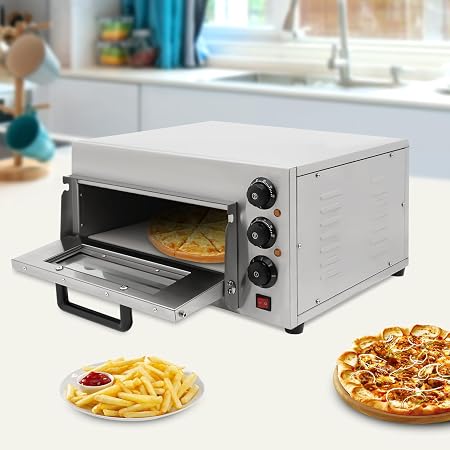
1300W Electric Pizza Baking Oven
$145 price checked August 2026
Read our full Electric Pizza Oven review
To maximize your output, see the best countertop convection oven for large sheet pans.

What Happens if You Under-Size or Over-Buy Capacity?
Under-sizing your convection oven capacity leads to a failure in airflow and heat distribution. If you select a unit that is too small for your required tray size, you risk uneven heat distribution, which results in scorched edges and raw centers on large-batch baking.
You should also evaluate the required power for convection ovens to ensure your kitchen can handle the load.
The Risks of Under-Sizing
When the interior volume is too small for the product being baked, the air cannot circulate freely around the items. This creates “cold spots” where the convection fan cannot push hot air into the gaps between products. You may find yourself forced to bake in smaller, less efficient batches, which increases the time spent on each cycle and slows down your production workflow.
The Real Cost of Over-Buying
Over-buying capacity is a significant expense that impacts your workspace and your budget. A larger convection oven requires a larger physical footprint in your kitchen, which may be a constraint in a professional environment. Furthermore, a larger interior volume often requires a higher wattage to maintain consistent temperatures, which can lead to increased energy costs for a capacity you may never fully utilize.
What Is the Most Common Capacity Mistake?
The most common mistake buyers make with convection oven capacity is prioritizing total volume over usable interior dimensions. A high Cu. Ft. rating can be misleading if the internal geometry does not accommodate the specific tray sizes you use daily.
Dimensions vs. Total Volume
You should optimize for the “clearance” around your trays rather than just the total Cu. Ft. count. If a convection oven has a 1.5 Cu. Ft. capacity but the interior width is only 10 inches, you cannot fit a standard commercial tray regardless of the total volume. Always confirm the internal width and depth measurements against the dimensions of your pans before ordering.
Optimizing for Airflow
Instead of just seeking the largest number, focus on the spacing between your products. Proper convection baking relies on the “air gap” between items. If you crowd a small oven to its maximum capacity, the convection fans cannot move enough air to cook the centers of the products. It is better to choose a slightly larger capacity that allows for proper spacing than a smaller unit that forces you to bake single items.
Make sure to verify the correct voltage for convection ovens before making your final purchase.
How Does Capacity Interact With Other Specs?
Convection oven capacity interacts directly with power requirements and heat distribution capabilities. A high Cu. Ft. figure is wasted if the power supply cannot maintain the required temperature for that volume.
Power Draw and Capacity
The 240V power standard is a critical threshold for high-capacity ovens. Because larger ovens require more energy to heat a larger volume of air, many high-capacity units require a dedicated 240V circuit. If you only have access to a standard 120V outlet, your usable capacity is limited by the wattage the outlet can safely provide. You must confirm your building’s electrical capacity before selecting a large-volume oven.
Heat Distribution and Volume
The relationship between capacity and heat distribution is governed by the fan’s ability to move air through the entire volume. In larger ovens, the distance the air must travel increases. If the oven does not have a high-quality fan system, a larger Cu. Ft. rating may result in inconsistent cooking. When evaluating capacity, ensure the unit is designed to distribute heat evenly across the entire interior space to prevent the “scorched edge” failure mode.
Workflow and Tray Standards
Capacity must be matched to your specific production workflow. If your workflow relies on half-size sheets, a 1.5 Cu. Ft. oven is the baseline. If you move to full-size sheets, you must jump to a higher capacity tier to ensure the oven can handle the footprint. Choosing a capacity that does not align with your standard tray sizes will force you to change your entire production process to fit the equipment.
The other Pro Convection Oven guides we have published
- Countertop Convection Ovens for Large Sheet Pans Compared
- Choosing the Best Countertop Convection Oven with Digital Controls
- The Pro Convection Ovens That Work Best for Baking
- Commercial Countertop Convection Ovens for Pizza Baking Compared
- Choosing the Best Half Size Countertop Convection Oven
- The Quarter Size Countertop Convection Ovens That Work Best for Small Spaces