
Professional convection ovens typically require between 3,000W and 15,000W of power depending on the unit’s capacity and voltage requirements. You should select a wattage that aligns with your specific production volume to ensure the oven can recover heat quickly enough for consistent baking.
Recommended Power for Convection Ovens by Use Case
| Use Case | Recommended Power | Why this number |
|---|---|---|
| Small Batch / Home Use | 1,200W – 1,800W | Sufficient for standard countertop volumes on a 120V circuit. |
| High-Volume Countertop | 1,800W – 3,000W | Provides faster recovery times for rapid-fire small batch baking. |
| Commercial Half-Size | 3,000W – 6,000W | Necessary to maintain steady temperatures for 1.5 Cu. Ft. capacities. |
| Full-Size Commercial | 6,000W – 12,000W | Required to heat large internal cavities and maintain even heat distribution. |
| High-Output Industrial | 12,000W – 15,000W+ | Unlocks high-wattage heating elements for full-size pan capacity on 240V. |
Pro Convection Ovens we have reviewed in detail
These 3 have their own full review on this site, and run from $145 to $549.
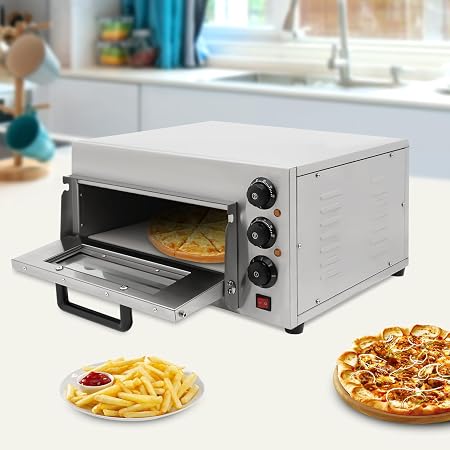
1300W Electric Pizza Baking Oven
$145 price checked August 2026
Read our full Electric Pizza Oven review
If you prefer precise temperature adjustments, compare the best countertop convection oven with digital controls for your kitchen.


Avantco CO-16 Half Size Countertop Convection Oven
$549 price checked August 2026
For those focusing on pastry production, view our guide to the best countertop convection oven for baking to see top-performing models.
Risks of Under-Provisioning or Over-Buying Power
Consequences of Insufficient Wattage
Insufficient wattage causes the oven to lose temperature too quickly when the door is opened or a cold product is inserted. If the power draw is too low for the internal volume, the heating elements cannot replace the lost heat fast enough to maintain a steady environment. This leads to uneven heat distribution, resulting in scorched edges and raw centers on large-batch baking because the oven spends too much time “recovering” rather than “cooking.”
The Practical Cost of Over-Buying
Over-buying power is a tangible cost because high-wattage units often require 240V power, which necessitates a dedicated circuit and professional electrical installation. If you do not have the volume to justify a high-output unit, you pay for electrical infrastructure and a larger footprint that remains underutilized. Furthermore, higher wattage units may increase the operational cost per bake if the oven is frequently cycled for small loads that could have been handled by a more efficient, lower-wattage model.
The Common Mistake with Power and What to Optimize Instead
The most common mistake is assuming that a higher wattage rating automatically translates to a better bake for every application. While wattage provides the “muscle” to generate heat, it does not dictate the “intelligence” of the heat distribution. You should focus on optimizing the airflow and humidity control rather than just chasing the highest wattage number available.
Before finalizing your purchase, research the standard convection oven warranties to understand what coverage you should expect.
Prioritizing Airflow and Circulation
A high-wattage oven with poor fan placement will still produce inconsistent results. You should prioritize the fan’s ability to move air across all surfaces of the product. In a professional convection oven, the goal is a uniform velocity of air that ensures every side of a tray receives equal heat exposure. A 6,000W oven with superior airflow will outperform a 9,000W oven with stagnant air pockets every time.
The Importance of Humidity Regulation
For many professional applications, the ability to control moisture is more critical than the raw speed of heating. High-volume production often requires precise humidity levels to achieve specific textures in bread or pastry. Look for units that offer dedicated humidity controls, as these allow for a more consistent output than simply increasing the power draw of the heating elements.
How Power Interacts with Other Deciding Specs
Power is a primary driver of performance, but it is often limited by the physical dimensions and the electrical infrastructure of your workspace. A high wattage figure is wasted if the oven’s physical footprint is too small to accommodate your production workflow or if your facility cannot support the required voltage.
The 120V vs 240V Threshold
The distinction between 120V and 240V is a critical threshold for power requirements. Most standard household outlets provide 120V, which limits the available wattage for any single appliance. If your production needs require a unit that exceeds the 1,800W mark, you will likely need to move to a 240V system. This transition is the point where the installation becomes a professional job requiring a qualified electrician to run a dedicated circuit.
Wattage vs. Internal Volume
The relationship between wattage and internal volume determines the oven’s recovery speed. A 3,000W oven is highly effective for a 1.5 Cu. Ft. capacity because the heating elements can quickly saturate that specific volume of air. However, if you attempt to use that same 3,000W output for a full-size commercial cavity, the heat will dissipate too quickly, and the oven will fail to maintain a consistent bake. You must match the wattage to the volume to ensure the oven can handle the thermal load of your specific products.
Where to go next in our Pro Convection Oven coverage
- Choosing the Best Half Size Countertop Convection Oven
- The Quarter Size Countertop Convection Ovens That Work Best for Small Spaces
- Which Countertop Convection Oven Is Best for Small Kitchens?
- Best Mid-Range Professional Countertop Convection Ovens for Restaurants
- Countertop Convection Ovens for Large Sheet Pans Compared
- Choosing the Best Countertop Convection Oven with Digital Controls