
When shopping for a gas metal arc welder, many listings use “premium” or “professional-grade” as marketing filler to justify a higher price. These terms carry no technical weight. To make an informed decision, you must ignore these adjectives and focus on load-bearing specifications like amperage, duty cycle, and voltage. These numbers dictate whether a machine can penetrate thick steel, how long it can run before overheating, and whether it can plug into a standard household outlet. By focusing on these measurable data points, you can determine exactly what a machine is capable of doing in a workshop environment.
Gas Metal Arc Welder Capability Terms
Gas metal arc welder capability determines the thickness of material you can join and the volume of work you can complete in a single session.
- Amperage – This measures the flow of current in amperes (A); higher numbers allow for deeper penetration and faster melting of thicker metals.
- Voltage – Measured in volts (V), this determines the “push” of the arc; higher voltage is typically required for thicker materials and deeper penetration.
- Duty Cycle – This is a percentage (e.g., 60% at 200A) indicating how long a welder can operate at a specific amperage before it must cool down; a higher percentage means the machine can handle more continuous work.
- 200 Amps – This is the specific threshold where a welder can reliably penetrate 1/4-inch thick mild steel; machines below this may struggle with heavy-duty structural work.
- IGBT Inverter Technology – This refers to the internal power electronics that convert electricity into a welding arc; these are the standard for modern power efficiency and a compact machine footprint.
- Wire Feed Speed – Measured in feet per minute (fpm), this dictates how fast the welding wire is pushed into the torch; faster speeds are required when using thicker wire or larger weld beads.
Where these choices show up in our reviews
These 3 have their own full review on this site, and run from $104.99 to $175.98.

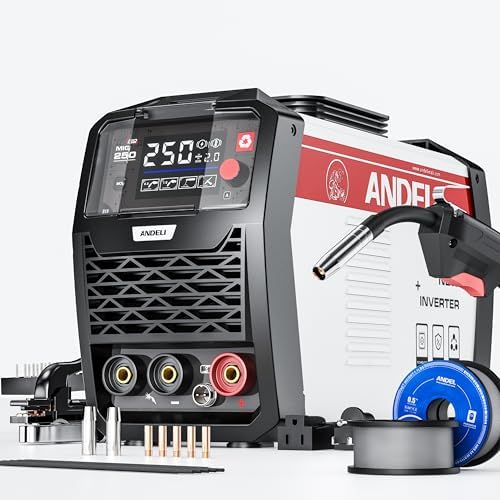
ANDELI MIG 135Amp 110V/220V IGBT Inverter Welder
If you are ready to upgrade your setup, explore the best entry-level professional MIG welder options available today.
$104.99 price checked August 2026

hynade MIG135FX 110V 3 in 1 MIG Welding Machine
$129.99 price checked August 2026
Read our full hynade MIG135FX review
Understanding your options is easier once you see the different types of MIG welders explained in detail.
Gas Metal Arc Welder Power and Compatibility
Gas metal arc welder power and compatibility terms tell you where you can physically use the machine and what type of gas or wire it requires.
- 110V/220V Dual Voltage – This indicates the machine can run on standard household outlets (110V) or industrial high-voltage lines (220V); dual voltage provides the most flexibility for different workspaces.
- MIG (GMAW) – This is the technical standard for Gas Metal Arc Welding; it identifies the process used when a wire electrode is fed through a torch.
- Flux Core (FCAW) – This is a variation of the MIG process that uses a wire coated in flux; it allows for welding in the wind or outdoors without a gas cylinder.
- Gas Cylinder Compatibility – This confirms if the machine can accept external shielding gases like CO2 or 75/25 mixes; compatibility is required for high-quality MIG welding on thin materials.
- Wire Diameter – Measured in inches (e.g., .030″ or .035″), this determines the thickness of the consumable wire; smaller diameters offer more control for thin sheets, while larger diameters are for heavy fabrication.
Gas Metal Arc Welder Failure Modes
Gas metal arc welder failure modes describe what happens when the machine is pushed beyond its technical limits or used in incorrect conditions.
- Duty Cycle Overload – This occurs when the machine is used for longer than its rated percentage, causing the internal components to overheat and the machine to shut down.
- Voltage Drop – This happens when using a 110V machine on a long extension cord, resulting in poor penetration and “cold” welds because the power loses strength over distance.
- Wire Feed Jam – This is a mechanical failure where inconsistent tension or incorrect wire diameter causes the machine to stop mid-weld; consistent tension settings are required to prevent this.
Commonly Confused Gas Metal Arc Welder Terms
Buyers often confuse these terms because they appear in similar contexts but represent different mechanical functions.
MIG vs. Flux Core
MIG typically refers to the use of an external gas cylinder to protect the weld, while Flux Core refers to a wire that provides its own protection. If you need to weld outdoors in windy conditions, Flux Core is the standard choice because it does not require a gas tank.
Amperage vs. Voltage
Amperage is the volume of electricity (the “flow”), while voltage is the pressure of that electricity. For most projects, you increase amperage to weld thicker metal and increase voltage to ensure the weld penetrates deeply into the base material.
Duty Cycle vs. Amperage
Amperage tells you how much power the machine has, but duty cycle tells you for how long it can provide that power. A machine might be rated for 200 Amps, but a 20% duty cycle means it can only run at that level for 12 seconds before needing to cool down.
Browse our other Gas Metal Arc Welder pages
- Choosing the Best MIG Welder for Home DIY Projects
- The 110V MIG Welders That Work Best for Beginners
- Which Budget MIG Welder Is Best for Aluminum?
- Best 3-in-1 MIG Welders for Flux Core and Stick
- Portable MIG Welders for Small Spaces Compared
- Choosing the Best Dual Voltage MIG Welder for 110V and 220V